Filter Differential Pressure Explained: When to Change Out
Share
Filter differential pressure (ΔP or psid) is the inlet pressure minus the outlet pressure across a filter housing while liquid is flowing, and it rises as trapped solids plug the bag or cartridge pores. On a properly sized clean liquid filter, manufacturers aim for an initial pressure drop of 2 psi or less and change out bags around 15 psid or cartridges around 20 to 30 psid before media failure.
- Two pressures, two jobs. Line pressure loads the stainless shell against the room; differential pressure loads the bag or cartridge inside.
- One gauge is half the number. A single lid gauge reads upstream pressure only, unless your outlet discharges straight to open air.
- Gauges are sold separately on our housings. Your liquid, line pressure, and port thread set the gauge scale and wetted material, so we do not ship a generic gauge in the box.
- Gauge mounting depends on the model. Standard 2.5 in and 4.5 in jumbo housings use pipe tees; our cast-head sanitary single-cartridge housing has two 1/8 in head gauge ports; custom vessels get upstream and downstream taps on the approval drawing.
What is filter differential pressure, and how does it differ from line pressure?
Filter differential pressure is the pressure lost between the dirty inlet side and the clean outlet side of a filter element (inlet pressure minus outlet pressure) at your operating flow rate. Line pressure, also called working pressure, is the total pressure inside the housing relative to outside air, which the vessel wall and lid seal hold.
Buyers mix these two numbers up every week. If a pump feeds water at 70 psi and the outlet gauge reads 68 psi on a fresh element, line pressure is 70 psi and differential pressure is 2 psid. When the outlet drops to 50 psi later, the shell still holds 70 psi, while the element carries a 20 psid push across its wall.
Our catalog keeps both limits separate. Our 1.5 mm 2.5 in clamp housing lists 0.8 MPa (8 bar, about 116 psi) maximum working pressure and our 2.0 mm clamp housing lists 1.0 MPa (10 bar, about 145 psi), while bag and multi-cartridge vessel ratings are stated on the quote and drawing. Reusable SUS304 and SUS316L mesh cartridges carry a conservative default maximum pressure of 6 bar (87 psi) and a conservative default maximum temperature of 60 °C (140 °F) for the cartridge, covered in stainless steel filter cartridge pressure limits.
Why does differential pressure rise across a filter bag or cartridge?
Differential pressure rises because captured solids plug open pores or mesh openings, leaving less open area for liquid to pass through. Pushing the same flow rate through fewer open passages takes higher upstream pressure, and the climb gets much steeper once most of the filter area is blocked near the end of a run.
Pressure drop stays flat for most of a cycle, then climbs steeply once half the open area is gone and velocity through the remaining pores doubles. Before blaming the media, check three variables:
- Higher flow rate. Opening a downstream valve wider or speeding up a pump raises ΔP on a clean element.
- Cold, viscous liquid. Cold oil, syrup, glycol, or resin at startup creates a higher ΔP than warm liquid later.
- Undersized housing. Rosedale Products notes in its industrial filter bag guide that elements are usually sized so clean pressure drop does not exceed 2 psi. Starting at 8 to 10 psid clean means you need more filter area.
How do you measure differential pressure on our stainless steel filter housings?
You measure differential pressure by reading upstream pressure before the filter element and subtracting downstream pressure after the element while liquid is flowing at normal rate. Across our stainless steel filter housings, pressure gauges are sold separately, and where those gauges sit depends on the housing family you buy.
Shelco's CSF cartridge housing manual gives the standard piping rule for inline housings without head taps: install gauges in the inlet and outlet piping to track cartridge life. Here is how each series in our store handles gauges.
| Our housing series | Gauge ports on the vessel | How to read ΔP | Supplied vs sold separately |
|---|---|---|---|
| 2.5 in threaded-lid housings (89 mm, drain or flat bottom) and slim 76 mm housing | No head ΔP taps; 1/2, 3/4, or 1 in NPT or G (BSPP) parallel thread ports | Fit gauge tees on the inlet and outlet pipes inside the shut-off valves | 89 mm includes gasket, SUS304 bracket, wrench and drain valve (both not stainless steel; flat bottom has no drain). Gauges sold separately |
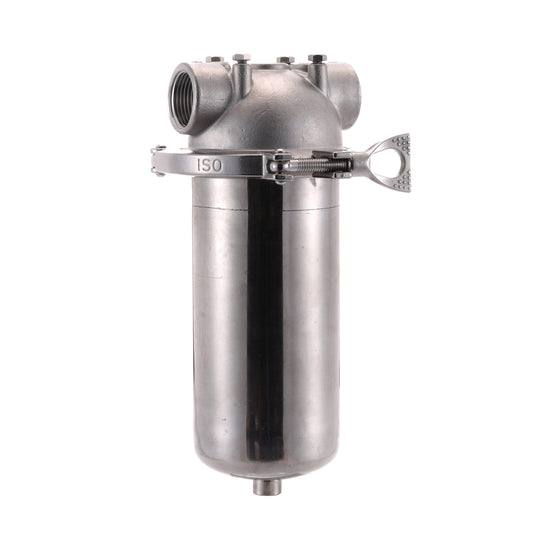
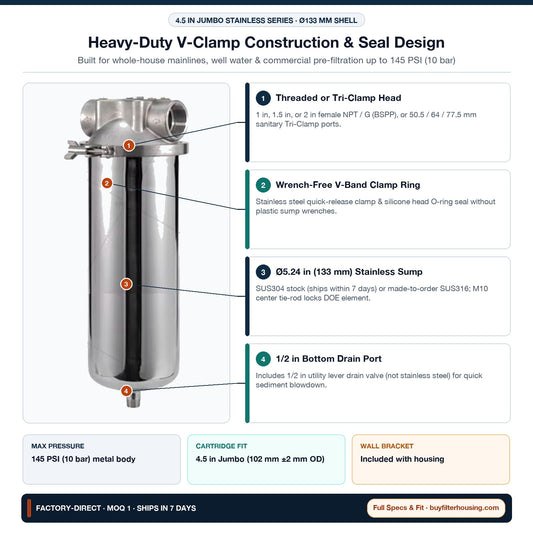
| 2.5 in clamp-lid housings (89 mm, 1.5 or 2.0 mm) and 4.5 in jumbo clamp housing (133 mm) | Clamp closure lid; NPT or G (BSPP) ports, plus 50.5, 64, or 77.5 mm Tri-Clamp options on jumbo | Fit inlet and outlet pipe gauges, or Tri-Clamp instrument tees on sanitary lines | Includes clamp ring, center rod and nut, gasket, SUS304 bracket, 1/2 in drain valve (not stainless steel). Gauges sold separately |
| Sanitary cast-head single-cartridge housing (50.5 or 64 mm Tri-Clamp, 5/10/20 in) | Cast SUS304 head includes a vent valve and two built-in 1/8 in gauge ports | Thread 1/8 in gauges onto the two head ports and subtract outlet from inlet | Includes cast head, vent valve, two 1/8 in gauge ports, and bowl. Cartridge, clamps, gaskets, gauges sold separately |
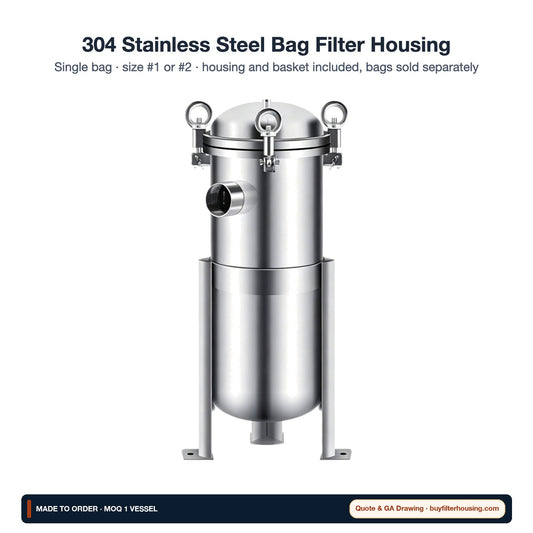
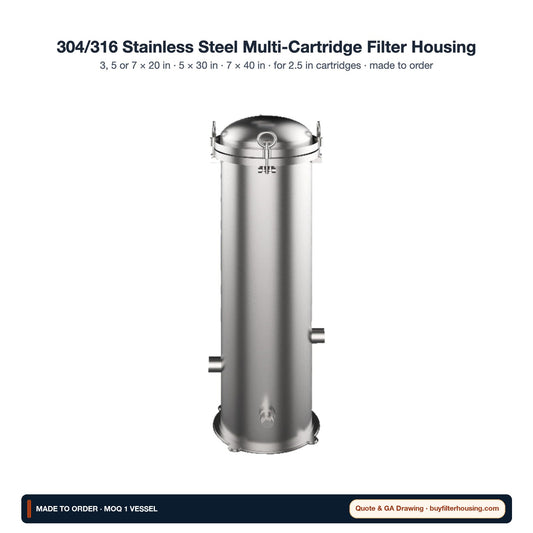
| Single bag (#1–#4), multi-bag housings (2–10 × #2), and multi-cartridge vessels | Lid vent/gauge port and nozzle taps confirmed by email and on the GA drawing | Read one tap on the dirty chamber and one on the clean chamber or outlet nozzle | Includes vessel and basket or plate; standard sizes ship within 7 days after confirmation. Gauges quoted on request |
Check two connection details before buying fittings. Our BSP ports are G (BSPP) parallel thread, not NPT and not PT/R tapered thread, so G stems seal against a flat washer rather than tape alone. Also keep Clamp Closure (the band clamp on the lid) separate from Tri-Clamp Ports (sanitary pipe ferrules).
At what differential pressure should you clean or replace a filter?
Clean or replace the element at the maximum differential pressure listed by your bag or cartridge maker, or sooner if downstream flow falls below what your equipment requires. As published benchmarks, Rosedale Products recommends changing filter bags at 15 psid and cartridges at 30 psid, while Commercial Filtration Supply cites 20 to 25 psi for liquid bags.
Swapping bags by the calendar wastes clean media in light weeks and risks blowouts on dirty batches. Commercial Filtration Supply notes that ΔP tracks real pore loading. Keep three habits:
- Log clean ΔP on day one. Record clean inlet pressure, outlet pressure, and flow rate when fitting a fresh nominal felt or stainless mesh filter bag or cartridge.
- Stop below the limit. On PP needle-felt bags (5, 25, and 100 µm nominal), changing near 15 psid protects seams. On reusable mesh cartridges (marked by mesh count), washing earlier keeps grit out of the weave; see how to clean a stainless steel filter cartridge.
- Treat a sudden ΔP drop as bypass. If ΔP climbs to 18 psid and drops to 3 psid at steady flow, a bag tore or a DOE cartridge unseated. Isolate, depressurize, and inspect.
How do we put differential pressure ports onto a custom vessel drawing?
On a custom bag or multi-cartridge vessel, we list two separate instrument ports in the nozzle schedule of the general-arrangement (GA) drawing: an upstream port opening into the dirty chamber above the basket or tube sheet, and a downstream port opening into the clean chamber or outlet nozzle, with exact thread, height, and orientation.
On custom filter housings (MOQ 1, SUS304 or SUS316/316L housing body verifiable by PMI, built after drawing approval), "one gauge port" gives a lid tap that reads inlet pressure only. When downstream piping has back-pressure, confirm these five items on the GA sheet (see how to read a filter housing drawing):
| Drawing item | Vessel location | What to confirm on the GA drawing |
|---|---|---|
| Upstream high-pressure tap | Cover, upper shell above basket or tube sheet, or inlet nozzle | Nozzle mark, elevation, and plan angle facing the walkway |
| Downstream low-pressure tap | Clean plenum below basket/plate or outlet nozzle neck | Required when downstream piping runs under back-pressure |
| Separate air vent | Highest point on the cover dome | Kept separate so bleeding air at startup does not spray the gauge |
| Port standard | Nozzle schedule | Write 1/4 in NPT or 1/4 in G (BSPP) parallel thread (not NPT, not PT/R), or Tri-Clamp ferrule OD |
| Valve material | Parts list and quote | SUS304/316 applies to the housing body; standard drain valves are not stainless steel, so specify stainless valves upfront |
Every vessel is built to approved drawing dimensions, and standard catalog models ship within 7 days. For full selection steps, read our stainless steel filter housing buyer's guide.
FAQ: filter differential pressure
Can one pressure gauge on the lid measure differential pressure?
Only when the outlet discharges straight into an open atmospheric tank. On any closed pipe loop or multi-stage filter train, you need an inlet reading and an outlet reading, or a two-port differential gauge.
Why did differential pressure drop suddenly without changing the element?
A sudden drop at steady flow means internal bypass: a torn bag, a crushed cartridge core, an unseated DOE cartridge, or a blown seal. Shut both valves, bleed pressure at the drain, and inspect inside.
Do SSFILTERHOUSING housings include pressure gauges?
No, gauges are sold separately across our 2.5 in, 4.5 in jumbo, sanitary, bag, and multi-cartridge housings. Our cast-head sanitary single-cartridge housing has two 1/8 in head gauge ports, standard inline housings use pipe tees, and custom vessels get ports per your drawing.
Why is clean differential pressure high on a brand-new filter?
Either the housing has too little filter area for the flow rate, the liquid is cold and viscous, the rating is finer than needed, or a downstream valve is partly shut. Equal high readings on both gauges indicate downstream restriction.
Does a higher housing working pressure allow higher differential pressure?
No. Stepping from our 1.5 mm clamp housing (0.8 MPa / 8 bar) to our 2.0 mm clamp housing (1.0 MPa / 10 bar) raises what the stainless shell holds, not what the bag or cartridge inside can survive.
Need upstream and downstream ΔP ports placed on a bag or multi-cartridge vessel, or help sizing for a low clean pressure drop? Contact us with your liquid, flow rate, line pressure, element rating, and port standard (NPT, G (BSPP), flange, or Tri-Clamp), or request a drawing on our custom filter housings page.