Stainless Steel Filter Cartridge Pressure Rating Explained
Share
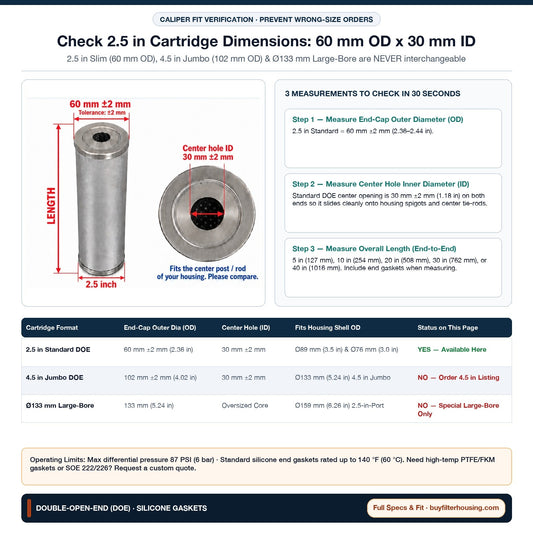
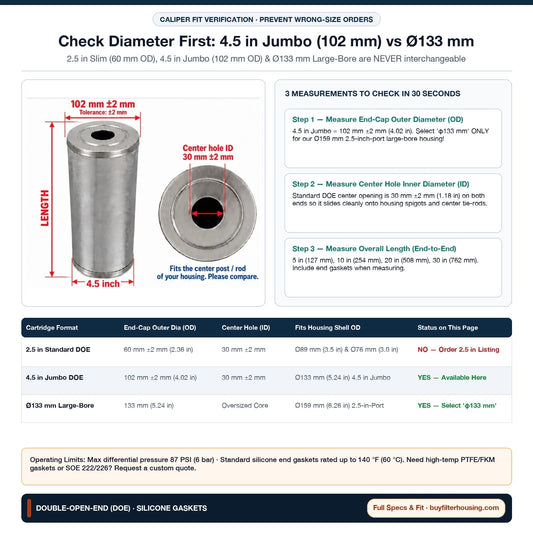
The stainless steel filter cartridge pressure rating we state for our mesh cartridges is a conservative default of 6 bar (87 psi), with a conservative default temperature limit of 60 °C (140 °F). Both figures describe the cartridge only. The housing it sits in has its own design pressure and temperature, stated by the manufacturer for that model, and the cartridge figure does not become the rating of the system. The pressure that damages a mesh cartridge is almost never the line pressure; it is the differential pressure across the cartridge as it loads, and a pressure surge at start-up. The temperature limit sits where chloride stress corrosion cracking of 304 and 316L becomes a risk and gasket materials lose margin. The essentials:
- Cartridge pressure: 6 bar (87 psi), conservative default, for the stainless mesh cartridges listed on the product pages.
- Cartridge temperature: 60 °C (140 °F), conservative default, same cartridges.
- What actually crushes a cartridge: differential pressure from plugging, and water hammer when a housing is filled too fast.
- Housing limits: separate, model by model, on the manufacturer's drawing or quotation; not given in this article.
- 316L does not raise them: the grade is about chloride, not pressure or temperature.
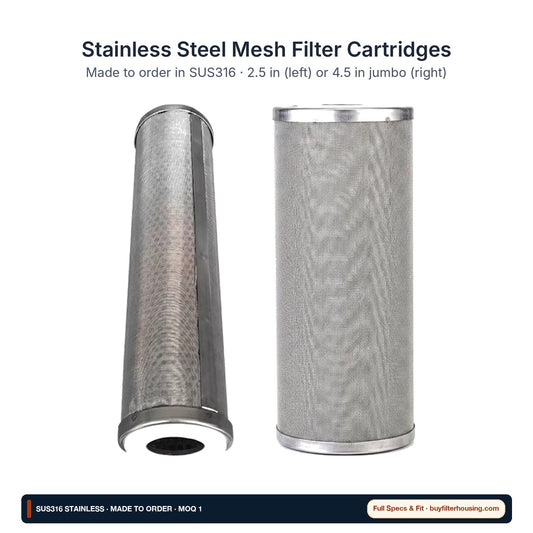
This is the limits chapter of our stainless steel filter housing buyer's guide, for the reusable stainless steel mesh cartridges. The figures are on each product page; this article explains what they mean and what to do with them.
What is the stainless steel filter cartridge pressure rating?
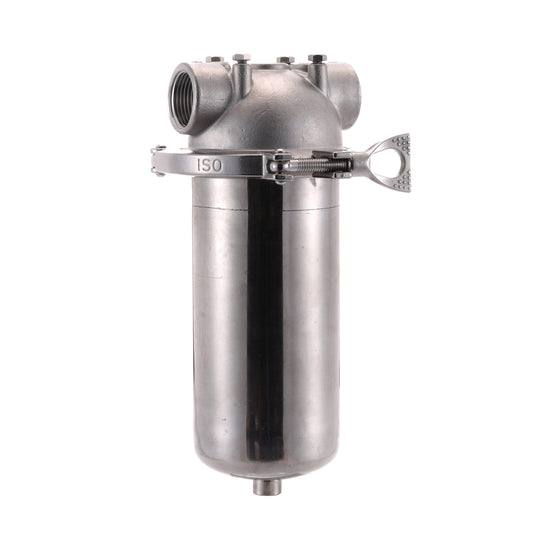
A ceiling we have chosen deliberately low. The mesh cartridges are listed with a maximum pressure of 6 bar (87 psi), and we call it a conservative default because it is a figure we can state for every length and mesh grade in the range without qualification, not a tested limit for any one of them. We state one figure rather than separate line and differential values, and because it is conservative we apply it to both: the cartridge should not sit in a line above it, and the differential across it should stay well below it. The product page adds the sentence that matters most for system design: "The housing does not inherit this rating as a system rating." A 2.5 in or 4.5 in jumbo housing is a pressure vessel with its own design figures, set by the manufacturer for that model and wall, and the cartridge inside is a consumable with a ceiling of its own. The lower of the two governs the line.
Line pressure or differential pressure: which one crushes a cartridge?
Differential pressure. A cartridge in a housing is surrounded by liquid at line pressure on the outside and, through the mesh, nearly the same pressure on the inside; the metal feels only the difference between them. When the cartridge is clean that difference is small. As it loads, the difference grows, and all of it acts inward on the mesh. The filter industry describes element strength in exactly these terms. A hydraulic filter FAQ puts it in one line: "Collapse ratings are given in PSID (differential pressure)," where "Differential pressure is the difference in pressure from the inlet of the filter to the outlet of the filter," and notes that cartridge elements carry no burst rating because the housing, not the element, holds the system pressure (Aftermarket Filtration, hydraulic filter FAQ). A review of cartridge collapse says the same from the failure side: "One of the primary factors contributing to cartridge filter collapse is high differential pressure," and "As the filter becomes more clogged, the pressure differential increases, putting stress on the filter structure" (Patsnap Eureka, cartridge filter collapse). So the practical rule is the one from the cleaning article: fit gauges before and after the housing, record the clean reading, and clean or change the cartridge when the differential has risen by the increment your process can tolerate. A cartridge cleaned on schedule never approaches its ceiling; one left to plug on a strong pump will.
Why is the cartridge temperature limit 60 °C?
Three reasons, in order of seriousness. First, chloride stress corrosion cracking. Austenitic stainless steels under tensile stress in chloride-bearing water crack above a temperature threshold, and the Specialty Steel Industry of North America gives the threshold plainly: "it is rare to see chloride stress corrosion cracking at temperatures below 60 °C," adding that "standard grades such as 304/304L and 316/316L are very susceptible to this mode of attack" (SSINA, chloride stress corrosion cracking). A mesh cartridge is thin, welded and drawn wire under residual stress, which is the worst case for that mechanism, so 60 °C is the natural line for a cartridge in water whose chloride content we do not know. Second, the gasket. The cartridge seals against the housing through an elastomer gasket, and each gasket material has its own temperature limit, usually lower than the steel's; the quotation names the gasket material for your housing. Third, scale: hard water drops its calcium carbonate faster as it heats, and a hot cartridge scales between cleanings. If your duty is hot, say what the liquid is, its chloride content and the peak temperature, including cleaning cycles, and the answer will be specific to it rather than a default. A cartridge is removed before a hot clean-in-place cycle, not run through it.
What pushes a cartridge past its limits in practice?
Rarely a steady line pressure. The damage comes from events, and most of them are avoidable with a gauge and a slow hand on the inlet valve.
| Situation | What the cartridge sees | Prevention |
|---|---|---|
| Cartridge left to plug | Differential climbs toward the ceiling; mesh dents inward, pleats close | Gauges each side; clean on the differential increment, not the calendar |
| Housing filled too fast | Water hammer: a shock wave into an air-filled housing | Open the inlet a quarter turn, vent the air, wait, then open further |
| Pump started against a closed outlet | Full pump shut-off pressure on the housing and cartridge | Open the outlet first; interlock the pump to it |
| Cold or viscous liquid | Higher differential at the same flow | Size the cartridge for the viscosity, or warm the liquid within the limit |
| Hot sanitizing or hot CIP | Above the temperature default, in chloride water | Remove the cartridge before the hot cycle |
| Frozen housing | Ice expansion against the mesh and the housing | Drain or heat-trace an outdoor housing |
| Vent left closed | Trapped air cushions, then slams; flow bypasses the top of the mesh | Vent on every fill |
Water hammer is the one most buyers have never been warned about. A filter system supplier describes the mechanism: "When water rushes into an empty system too fast, it creates a shockwave known as water hammer," and the fix is procedural: "Turn the inlet valve no more than one-quarter turn and wait 30 seconds," then open further in steps while the air leaves through the vent (Crystal Quest, turning a system on too quickly). The shock lands on the housing seals and on the cartridge end faces, which on a double open end cartridge are the seal; a hammered cartridge often shows as a dented end face that no longer sits flat.
How do cartridge limits and housing limits fit together?
As a chain, where the line is rated by its weakest link and each link is rated by someone different. The cartridge figure is ours, stated above as a conservative default. The housing body's design pressure and temperature belong to the housing manufacturer, model by model, and are stated on the drawing or the quotation for that housing; this article gives no housing figures, and how to read a filter housing drawing explains where to find them and why not to fill the blank yourself. The gasket has the limit of its material. The drain valve, the gauge and the vent each carry their own, and the drain valve is not stainless steel. When a buyer asks "what is the system rated for," the honest answer is the lowest of those, read off the documents for each part, and for the stainless housings in our range that reading starts from the quotation, not from the cartridge page.
| Part | Who states the limit | Where to find it | Note |
|---|---|---|---|
| Mesh cartridge | Us | Product page | 6 bar (87 psi), 60 °C (140 °F), conservative default |
| Housing body | Housing manufacturer | Drawing, quotation | Model by model; not inherited from the cartridge |
| Head gasket | Gasket material maker | Quotation names the material | Often the lowest temperature limit in the chain |
| Drain valve, gauge, vent | Component makers | Quotation | The drain valve is not stainless steel |
| Pipework and pump | Your design | Your drawings | Pump shut-off pressure sets the worst case |
FAQ
Can I run the cartridge at exactly 6 bar?
Treat it as a ceiling with margin below it, not a set point. The figure is conservative, but a line that sits at the ceiling leaves nothing for the differential to rise into. Keep the line pressure below it and watch the differential.
Is 6 bar the line pressure or the differential pressure?
We state one conservative figure and apply it to both. In practice the line pressure is set by your system and the differential is what you control by cleaning on schedule.
My line runs above 6 bar. Can I still use a stainless mesh cartridge?
Not under the default. Send the line pressure, the pump shut-off pressure, the liquid and the flow, and we will say what can be offered for that duty rather than stretch a default to cover it.
Can the cartridge go through a hot clean-in-place cycle?
Not above 60 °C under the default, and not in chloride-bearing cleaning solutions at any temperature near it. Remove the cartridge, clean it by the six-step routine, and refit it after the cycle.
Does a 316L cartridge have a higher pressure or temperature limit?
No. The defaults are the same for both grades. 316L buys resistance to chloride pitting and to corrosion beside the welds, as 304 vs 316L for cartridges explains; it does not change the stress corrosion threshold or the mesh strength.
Does the housing have the same 6 bar and 60 °C limits?
No. The housing has its own design pressure and temperature, stated by the manufacturer for that model on the drawing or quotation. The cartridge figure describes the cartridge, and the housing does not inherit it as a system rating.
Running hotter, higher or dirtier than the defaults?
Send the line pressure, pump shut-off pressure, temperature, liquid and chloride level, and we will say whether the stainless mesh cartridge fits or what to use instead. Cartridges are ordered one at a time, the grade is verifiable by PMI, and housings are built and delivered to drawing dimensions with their own design figures on the drawing; for a housing specified to your line, start at custom filter housings or request a quote.