How to Clean a Stainless Steel Filter Cartridge in 6 Steps
Share
To clean a stainless steel filter cartridge, depressurize and drain the housing, take the cartridge out, rinse it from the inside out, soak it in warm water with a mild detergent, brush gently along the mesh with a soft nylon brush, rinse again, and inspect the mesh and end faces before refitting. Those six steps handle sediment and most organic loading; mineral scale needs a mild acid soak, and rust spots are almost always embedded iron from a steel tool. Clean on differential pressure, not on the calendar.
- Six steps: depressurize and drain; remove and rinse inside out; soak in warm water and mild detergent; brush along the mesh; rinse; inspect and refit.
- Never use: bleach or any chloride cleaner, hydrochloric acid, steel wool, a carbon steel wire brush.
- Scale: a citric acid or 25 percent vinegar soak, then a nylon brush and a thorough rinse.
- How often: when the pressure drop across the housing reaches the limit you set; the days between cleanings become your schedule.
- Replace instead: torn or stretched mesh, mesh pulled from an end cap, end faces that no longer sit flat.
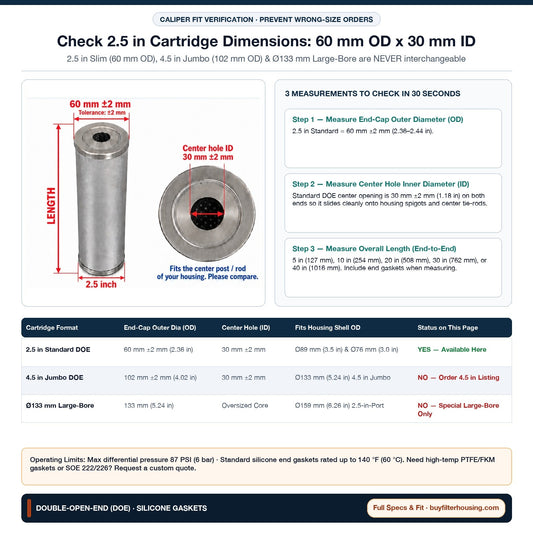
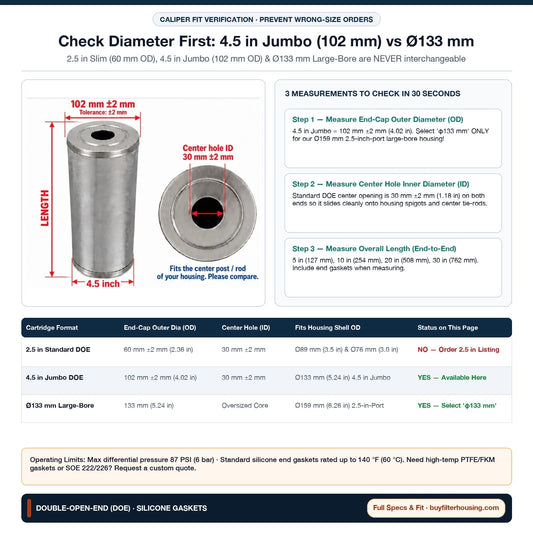
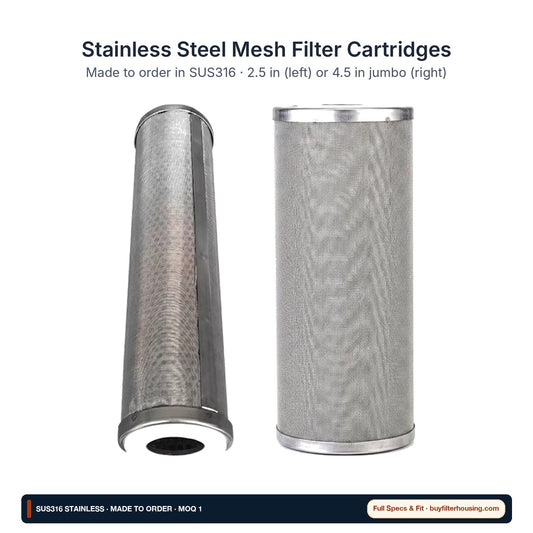
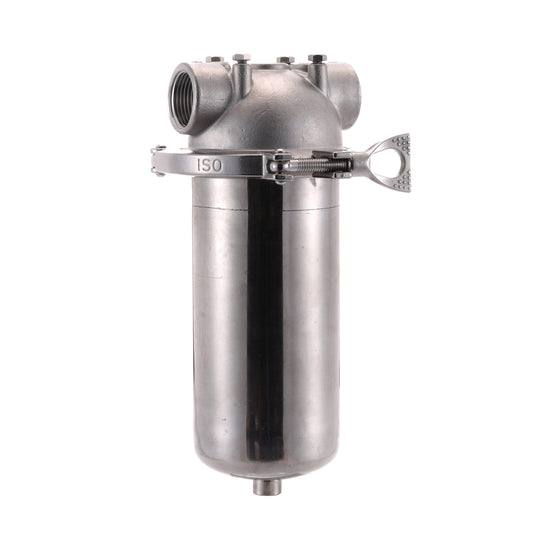
This is the maintenance chapter of our stainless steel filter housing buyer's guide, for the reusable stainless steel mesh cartridges in our 2.5 in, jumbo and large-bore housings. The routine works for any woven mesh cartridge; what changes between brands is the end style.
How do you clean a stainless steel filter cartridge?
In six steps, in this order: the first is about safety and the last about whether the cartridge seals when it goes back.
Step 1: Isolate, depressurize and drain
Close the valves on both sides of the housing, open the vent so the gauge reads zero, then open the drain. A housing that still holds pressure sprays when the closure is loosened, and one that is not drained lifts the dirty cartridge through the clean liquid.
Step 2: Remove the cartridge and rinse from the inside out
Open the closure and lift the cartridge straight up; on the 4.5 in jumbo housing the center rod stays with the housing. Rinse with clean water from the inside outward, so the cake on the outside is pushed off the way it came rather than driven into the weave. Reverse flow is the first step a cleaning guide from Hengko gives for metal cartridges (Hengko, cleaning sintered and mesh filters).
Step 3: Soak in warm water with a mild detergent
Fill a clean bucket with warm water and a mild dish or laboratory detergent, and let the cartridge stand for twenty to thirty minutes. The British Stainless Steel Association's cleaning guidance names mild soap or detergent in warm water as the routine cleaner for stainless steel (BSSA, cleaning and maintenance of stainless steel). Warm means warm: the conservative default temperature limit we state for the mesh cartridges is 60 °C, and cleaning water has no reason to be hotter.
Step 4: Brush gently along the mesh
Use a soft nylon brush along the pleats or the weave, not across, with light pressure: the aim is to lift the loosened cake, not scrub the wires. Silt packs hardest in any fold lines and at the ring where the mesh meets each end cap. Never use steel wool or a carbon steel wire brush; the fragments embed in the stainless surface and rust there, which is the origin of most "rust" on a stainless cartridge.
Step 5: Rinse thoroughly
Rinse inside out again with clean water until the runoff is clear and there is no detergent foam. The woven wire industry's maintenance guidance is blunt on this point: "Thorough rinsing after use is very important" (Wovenwire.com, stainless steel screen maintenance). Detergent left in the weave ends up in your first liters of filtrate.
Step 6: Inspect, dry and refit
Hold the cartridge up to the light: the weave should look even, with no bright holes, stretched patches or gaps where the mesh meets an end cap. Then the ends. Our 2.5 in and 4.5 in jumbo mesh cartridges are double open end with flat ends and no O-rings, so the seal is made by the flat end faces pressing against the seats in the housing; a face that is dented, bent or carrying grit will bypass. Check the housing's own head gasket while the vessel is open; it is a separate part. Hengko's guidance is to "Dry the filter completely before reinstalling it in the system." Refit, close, vent as the housing fills, and record the clean pressure drop.
| Step | What you do | Tool | What to watch |
|---|---|---|---|
| 1 Depressurize | Isolate, vent to zero, drain | Valves, gauge | Gauge at zero before the closure moves |
| 2 Remove and rinse | Lift out, rinse inside out | Hose, clean water | Center rod stays with the jumbo housing |
| 3 Soak | Warm water, mild detergent, 20 to 30 minutes | Clean plastic bucket | No steel items in the bucket |
| 4 Brush | Light strokes along the weave | Soft nylon brush | Fold lines and end cap ring |
| 5 Rinse | Inside out until clear | Hose, warm water | No foam, no acid left behind |
| 6 Inspect and refit | Check mesh and end faces, dry, refit | Light, dry cloth | Flat end faces, housing gasket |
What should you never use on a stainless mesh cartridge?
Anything with chloride in it, and anything made of ordinary steel. The BSSA guidance puts it in one line, "Do not use chloride solutions," and adds that "Under no circumstances should concentrated bleaches contact decorative stainless steel surfaces," since splashes of undiluted bleach cause staining and micropitting. Hydrochloric acid is in the same category; the wire screen guidance: "Hydrochloric acid based solutions, such as silver cleaners, or building mortar removal solutions must not be used in contact with stainless steel mesh." Steel wool, carbon steel brushes and abrasive pads that are not iron-free leave particles that rust in the weave; a wire brush is acceptable only if it is itself stainless steel of the same or a better grade.
How do you remove mineral scale and rust spots?
With a mild acid, not a strong one. The BSSA guidance gives two routes for adherent scale: warm 10 to 15 percent phosphoric acid, neutralized and rinsed, or a 25 percent vinegar soak and a nylon brush. The woven wire guidance ranks citric acid as the least hazardous choice: "Citric acid cleaners are less potentially hazardous." Citric acid powder in warm water, or white vinegar diluted one part to three, a soak of an hour or two and a nylon brush removes most scale from a mesh cartridge. Rust spots are usually embedded iron, not corrosion of the cartridge; a non-scratching cream removes light marks and dilute oxalic acid removes embedded particles, with gloves, because oxalic acid is poisonous. Whatever acid you use, rinse until the water runs neutral.
| Deposit | Cleaner | Tool | Avoid |
|---|---|---|---|
| Silt, sand, sediment cake | Warm water and mild detergent | Hose inside out, soft nylon brush | Pressure washer at close range |
| Oil, grease, biofilm | Warm water and detergent, longer soak | Nylon brush, ultrasonic bath if available | Solvents in an enclosed space |
| Hard water scale, iron and manganese | Citric acid or 25 percent vinegar; warm 10 to 15 percent phosphoric acid for heavy scale | Soak one to two hours, nylon brush | Hydrochloric acid, descalers with chloride |
| Rust spots | Non-scratching cream; dilute oxalic acid for embedded particles | Soft cloth, gloves | Steel wool, carbon steel brush |
How often should you clean a stainless filter cartridge?
On differential pressure. Fit a gauge before and after the housing, record the reading with a clean cartridge, and clean when the pressure drop has risen by the increment your process can tolerate. The first cycles set the interval: if the drop reaches your limit every nine days, clean weekly. A finer grade loads faster, so a 5 µm cartridge on silty well water may need cleaning weekly where a 100 mesh screen on the same water runs for a month. A cartridge too small for the flow plugs sooner, which is a sizing problem to solve with a longer cartridge or a larger housing, not more frequent cleaning. Keep one spare per housing; the cartridges are sold one at a time.
When should you replace the cartridge instead of cleaning it?
When cleaning no longer returns the pressure drop to near the clean reading, or when the inspection in step six fails. A hole or stretched patch lets everything through and no cleaning fixes it. Mesh pulled away from an end cap, an end face that is dented or no longer flat, or a cartridge crushed by a pressure surge or by running dry are all replacements. The rating itself does not wear out: a mesh count is a property of the weave and stays unless the wires are stretched or broken. We do not put a number on how many cycles a cartridge lasts, because it depends on the liquid, the grade and how it is cleaned; the filter cartridge size guide covers how to measure a worn cartridge so the replacement fits.
FAQ
Can I clean a stainless steel filter cartridge in a dishwasher?
We do not recommend it. Dishwasher detergents are harsh and often chloride-bearing, and the cartridge rattles against steel racks. A bucket and a nylon brush do the job.
Can I use bleach to sanitize the cartridge?
No. Bleach is a chloride solution and pits and stains stainless steel. If your process requires sanitizing, use a non-chloride sanitizer your process allows, keep contact short and rinse completely. We make no sanitation claims for the cartridges; send us what you filter.
Can I backflush the cartridge without removing it?
Reverse flow in place loosens a light cake and stretches the interval, but it does not remove scale or the packed cake at the end caps. Do the six-step clean when the pressure drop no longer recovers after a backflush.
Does cleaning change the micron or mesh rating?
No. The rating is set by the weave and changes only if the wires are stretched, which is why step four says light pressure. Our cartridges are listed in 1 to 50 µm and 10 to 200 mesh, and a cleaned cartridge that passes inspection keeps its listed grade.
Is a 316L cartridge cleaned differently from a 304 one?
No, the routine and cleaners are the same. 316L is chosen for water with higher chlorides, not for easier cleaning; our mesh cartridges are 304 by default with 316L on request, and 304 vs 316 explains when the upgrade is worth it.
Need a spare on the shelf?
The 2.5 in mesh cartridge comes in 5 to 40 in lengths and the jumbo in 4.5 in and φ133 mm, each ordered one at a time, 304 by default with 316L on request, and the grade is verifiable by PMI. For a housing sized so the cartridge is not plugging every few days, or a multi-cartridge vessel built to your drawing, start at custom filter housings or request a quote.