OEM Stainless Steel Filter Housings: What Can Be Customized
Share
On an OEM stainless steel filter housing, six things are normally yours to specify: the port size and connection type, the inlet and outlet position, the closure, the surface finish inside and out, the supports and accessories, and the marking. Two things are not chosen so much as inherited: the element seat, which follows the bag size or cartridge end style you already use, and the design conditions, which the manufacturer states for the vessel rather than you. OEM means built to your specification and marked for you, from your drawing or one produced for approval, one piece at a time.
- Ports: size, thread form or flange standard, ferrule size, position and angle.
- Closure: threaded sump, clamp closure, swing bolt or bolted cover.
- Finish: inside and outside named separately, with an Ra value if your site needs one.
- Supports and accessories: legs or bracket, gauge ports, vent and drain valves.
- Marking: nameplate or laser mark, with your part number, logo and flow arrow.
- Confirmed on the quotation: not every combination is available on every housing.
This is the OEM chapter of our stainless steel filter housing buyer's guide. The quote checklist lists the ten items every inquiry needs; this article goes deeper on the five that make a housing yours.
What does OEM mean for a filter housing?
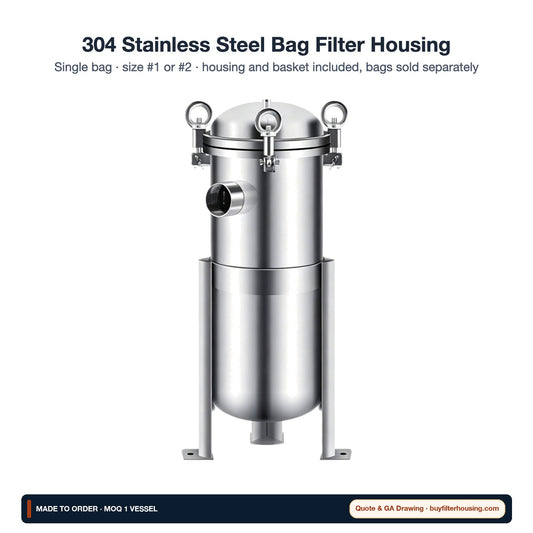
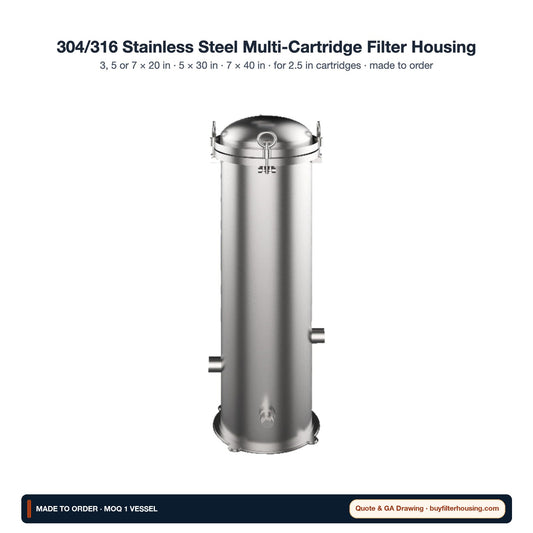
A catalog housing is a fixed design: one port size, one closure, one finish, the maker's name on the shell. An OEM housing starts from the same vessel family but carries your ports, layout, finish, supports and marking, so it drops into your skid or ships under your brand. Even large catalog ranges work this way. HART's industrial bag housings, for example, come in over-the-top, side-entry and clamped-cover styles with threaded ports and optional flanged, weld or sanitary connections, and the sheet still ends with "Custom fabricated housings available on request" (John Brooks, HART filter bag housings). The same split applies to our bag filter housings and multi-cartridge housings: standard sizes are ordered from the catalog; anything beyond them is quoted as a custom build.
What can be customized on an OEM stainless steel filter housing?
Ports and connections
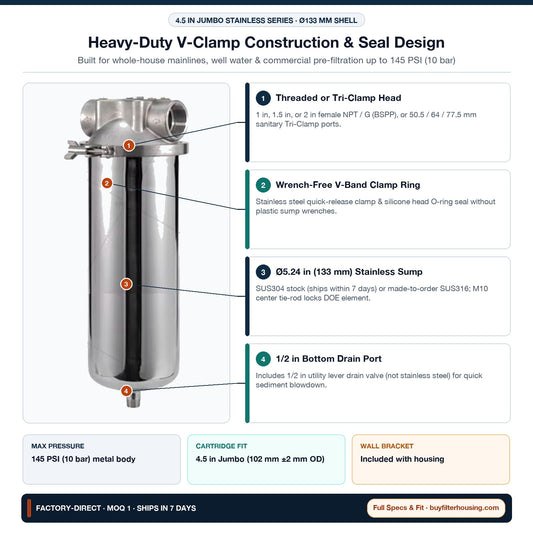
Three things per port: size, connection type and position. The connection type is where orders go wrong, so write it in full. Threaded ports are NPT or G (BSPP) parallel thread, not PT or R tapered thread; "1 in BSP" on its own does not say which, and the BSP housing page and NPT vs BSP explain why it matters. Flanged ports need the standard and the rating together, EN 1092-1 DN and PN or ASME B16.5 and class, plus raised or flat face. Tri-Clamp ports are specified by the ferrule outside diameter. Drain, vent and gauge ports are ports too: say how many, what size and where.
Inlet and outlet position
Side-in side-out, side-in bottom-out or in-line, with the angle between inlet and outlet if your pipework needs anything other than straight through or a right angle. On bag housings the inlet can also come through the cover; that top-entry layout is made to order, and side entry vs top entry covers when it is worth it. If you are not sure, send a sketch of the pipe runs; it is easier to move a nozzle on a drawing than to re-pipe a skid.
Closure
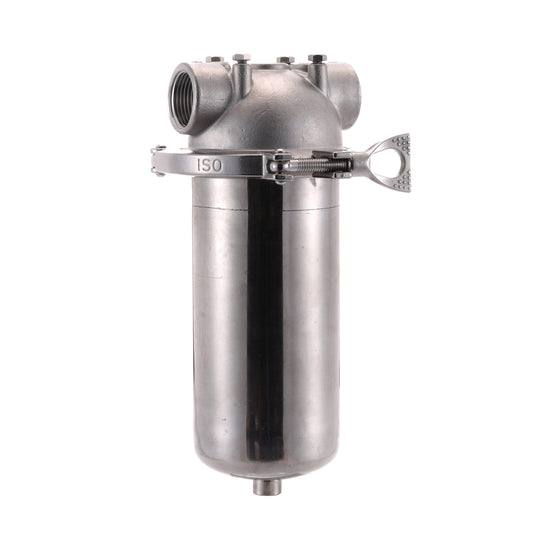
How the lid comes off decides how fast an element change is and how much headroom you need. Small single-cartridge housings use a threaded sump. Larger vessels use a clamp closure, a band clamp around lid and shell; swing bolts, which HART's sheet shows as a four-bolt lid on over-the-top housings and a three-bolt cover on side-entry ones (John Brooks); or a bolted cover for the largest. A clamp closure is a lid fastener, not a Tri-Clamp port; keep the two on separate lines of the inquiry. Choose by how often the housing is opened: a daily bag change wants a clamp or swing bolts, a yearly cartridge change can live with bolts.
Surface finish
Specify the inside and the outside separately, because they do different jobs. The outside is appearance: 2B mill, brushed or mirror polished. The inside is about residue and cleaning, and in food, beverage and pharmaceutical plants it is governed by a roughness number. A primer from Apache Stainless in Products Finishing puts it plainly: "Agencies require sanitary finishes to have a minimum roughness average (Ra)," and grit numbers alone are only a rough guide, so the finish is verified with a profilometer that averages the surface peaks and valleys (Products Finishing, sanitary stainless steel finishes). It gives typical ranges: 2B mill around Ra 40 microinches on heavy gauge sheet, No. 4 brushed at Ra 29 to 40 microinches, electropolishing improving Ra by up to half. So the useful line on an inquiry is not "polished" but "inside Ra 0.8 µm max, outside brushed," or simply "no finish requirement"; the quotation confirms what can be supplied for that vessel.
Supports and accessories
Legs or a wall bracket, fixed or adjustable, with the bolt pattern if the housing lands on an existing plinth; a tripod stand is the usual answer on floor-standing bag housings, and HART ships one as standard on its larger sizes (John Brooks). Then the small parts: gauge ports before and after the element for differential pressure, a vent at the top so the vessel fills without an air pocket, a drain valve at the bottom. Specify the drain and vent valves if you want them fitted; the valve is a separate line, and the drain valve we fit as standard is not stainless steel, so do not assume it from the shell grade.
Marking
OEM marking is what makes the housing yours on the plant floor: your part number, a serial number, port sizes, a flow arrow, your logo. There are two routes. A nameplate, riveted or tack welded, carries the most text and can be changed later. A mark on the shell itself is permanent, and here the laser terms matter. Laser marking, in Xometry's definition, "refers to placing legible information onto the surface of a part with little or no penetration"; on stainless steel it anneals the surface for a dark, high-contrast mark without removing metal. Laser etching melts a thin surface layer into a raised, permanent mark, the usual route for serial numbers, barcodes and logos. Laser engraving vaporizes a cavity you can feel, "typically" no deeper than about 0.020 in, and is the most durable of the three (Xometry, laser marking vs engraving vs etching). For a housing that will be cleaned and may be repolished, a nameplate or an annealed laser mark is the usual choice. Send the logo as a vector file and the text exactly as it should read; marking is confirmed on the quotation like every other option.
What stays fixed on an OEM housing?
The element seat. A bag housing is built around a bag size, #1 to #4, and the ring that bag uses; a cartridge housing around a cartridge length and end style, double open end or 222 or 226 O-ring. Choose the element first; changing the seat later means a different basket or tube sheet. The design pressure and temperature are also not yours to pick: the manufacturer states them for the vessel on the drawing or quotation, and you compare them with your line. Finally, the material grade is per part: SUS304 or SUS316 for the shell, SUS316L on our sanitary multi-cartridge housings, with gasket, fasteners and valves on their own lines. The body grade is verifiable by PMI on the finished housing, which this article explains.
OEM filter housing specification table
| Item | Options | What to write on the inquiry | Confirmed where |
|---|---|---|---|
| Material | SUS304, SUS316; SUS316L sanitary | Grade for the shell; note any gasket or valve requirement | Quotation and parts list |
| Port type | NPT; G (BSPP) parallel thread; flange DN/PN or ASME class; Tri-Clamp ferrule | Size and type per port, thread form or standard in full | Nozzle schedule on the drawing |
| Port position | Side-in side-out; side-in bottom-out; in-line; top entry (bag housings) | Layout and angle, or a sketch of the pipe runs | Plan view on the drawing |
| Closure | Threaded sump; clamp closure; swing bolt; bolted cover | How often opened, headroom available | Parts list |
| Finish | 2B mill; brushed; mirror polished; electropolished | Inside and outside separately; Ra if required | Title block and quotation |
| Supports | Legs fixed or adjustable; bracket; stand | Height, bolt pattern, floor or wall | Elevation on the drawing |
| Accessories | Gauge ports; vent valve; drain valve; spare elements | Which fitted, which loose | Quotation |
| Marking | Nameplate; laser marked, etched or engraved | Text exactly as it should read; logo as vector | Quotation |
How does an OEM housing order run?
You send the duty and the options above, or a drawing of your own. A quotation and a general arrangement drawing come back; how to read a filter housing drawing covers what to check before you sign. Nothing goes into production until the drawing is approved, the housing is built to it and delivered to the approved dimensions, photos of the finished housing go out before shipment, and the body grade is verifiable by PMI. One housing is a normal order. The custom filter housing page lists the housing families and sizes we build and the sanitary multi-cartridge range in the Tri-Clamp collection.
FAQ
What is the minimum order for an OEM filter housing?
One piece. A custom housing is built to one drawing, so a single vessel is the normal order.
Can you put our logo and part number on the housing?
Ask for it on the inquiry with the exact text and a vector logo, and say whether you prefer a nameplate or a mark on the shell. The quotation confirms the marking that can be supplied for your vessel.
Can you copy my existing housing?
Send a drawing, or photos with the key dimensions, the connection sizes and the bag or cartridge it takes, and you will be told whether it can be built.
Which finish do I need for a food or beverage line?
The one your site's standard calls for, written as an Ra value for the inside surface. If you have no written requirement, say so and the quotation names the finish supplied. Sanitary multi-cartridge housings are SUS316L with Tri-Clamp ports.
Do I need my own drawing to order an OEM housing?
No. Send the options in the table above and a drawing is produced for your approval. If you have one, send it and the quotation is made to it.
Ready to specify yours?
Pick the ports, layout, closure, finish, supports and marking, or send your own drawing, and the quotation and drawing come back for approval. Start at custom bag and multi-cartridge filter housings or request a quote.