Precision Filter Housing: Single vs Multi, When to Step Up
Share
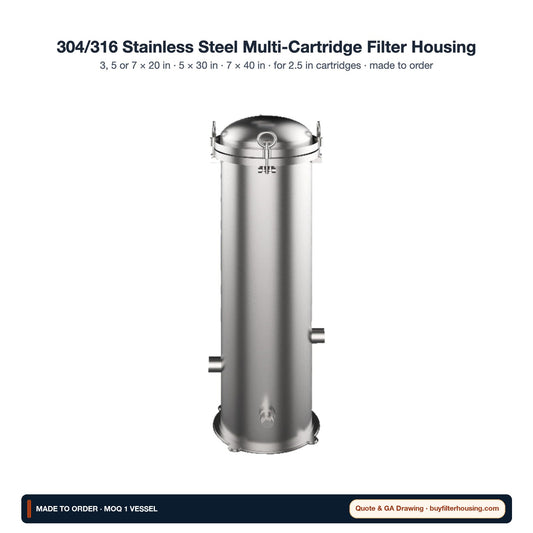
A precision filter housing is the industry's name for a multi-cartridge housing: one stainless steel vessel that holds several standard 2.5 in cartridges side by side on a common plate, so a single housing carries the flow that would otherwise need a row of single-cartridge housings. The same vessel is also called a security filter or a guard filter, because its most common job is protecting reverse osmosis (RO) membranes. You step up from a single housing to a multi-cartridge housing when one of five things is true:
- Pressure drop climbs too fast and cartridges are changed more often than you want.
- You already run two or more single housings in parallel on a manifold.
- You need a finer micron rating at the same flow, which needs more filter area.
- The housing feeds an RO system, where a guard filter is standard practice.
- The liquid is viscous, so each cartridge passes less than it would on water.
This is the multi-cartridge chapter of our stainless steel filter housing buyer's guide. Bag filter vs multi-cartridge housing covers the choice between bags and cartridges; this article covers the step from one cartridge to several.
What is a precision filter housing?
A pressure vessel with a cartridge plate inside. The plate, sometimes called a tube sheet, has one seat per cartridge; the cartridges stand in parallel between the plate and the lid, liquid enters the shell on the dirty side, passes through every cartridge at once and leaves through the plate on the clean side. The lid is a quick-open clamp or a bolted cover, and the seats are made for one cartridge end style: double open end (DOE), held by a spring and knife edge, or single open end (SOE) with 222 or 226 O-rings. Count and length are the two numbers in the model name. Our multi-cartridge filter housings hold 3, 5 or 7 cartridges of 20 in, 5 of 30 in or 7 of 40 in, in SUS304 or SUS316 with threaded or flanged ports for industrial lines, and in SUS316L with Tri-Clamp ports and a quick-open lid for sanitary lines. The format scales a long way: Rosedale's cartridge housing catalog runs from one cartridge to 205 in a single vessel (Rosedale Products, cartridge housings). "Precision" in the name does not mean the housing filters finer; the micron rating comes from the cartridge you fit, and a 2.5 in cartridge in a 7-round housing filters exactly as it does in a single housing.
How does a single cartridge housing differ from a multi-cartridge housing?
| What you are comparing | Single cartridge housing | Multi-cartridge (precision) housing |
|---|---|---|
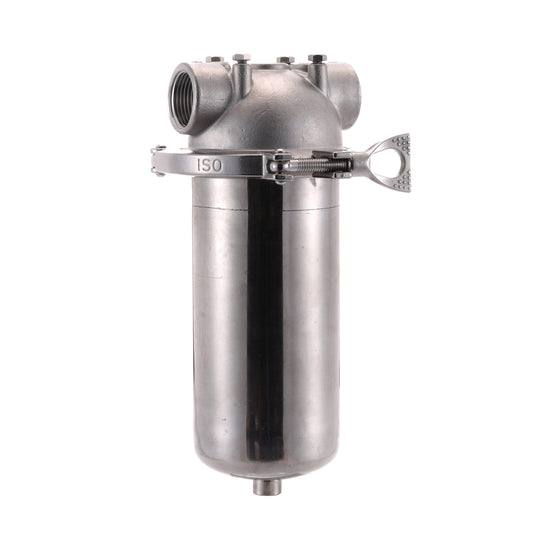
| Cartridges per vessel | One: 2.5 in × 5, 10 or 20 in, or one 4.5 in jumbo | Several standard 2.5 in cartridges: 3, 5, 7 or more |
| Flow at the same cartridge and rating | What one cartridge passes at an acceptable pressure drop | Roughly that figure times the cartridge count |
| Ports | 1/2 to 1 in threads on 2.5 in housings; 1 to 2 in on jumbo | Threaded or flanged, sized to the duty; Tri-Clamp on sanitary models |
| Closure | Threaded sump or clamp lid | Quick-open clamp or bolted cover; one lid for all cartridges |
| Change-out | One cartridge, one housing at a time | All cartridges in one stop |
| Instrumentation | Usually none | Gauge ports in and out for differential pressure; vent and drain |
| Footprint and pipework | Small; several in parallel need a manifold | One vessel, one inlet, one outlet |
| Supply | Standard catalog models at listed prices | Built to your duty; ports, closure and end style confirmed before production |
| Typical duty | Point of use, small process lines, whole house | RO pre-filtration, process water, food and beverage, chemicals |
The row that matters most is change-out. A multi-cartridge housing does not just carry more flow; at the same flow it carries less flow per cartridge, and that is what changes the running cost.
When should you step up from single to multi-cartridge?
1. Cartridges clog faster than you can live with
Filter life is a balance between the dirt arriving and the dirt each cartridge can hold, and the second number falls as flow per cartridge rises. 3M's sizing brief puts it directly: "The dirt holding capacity of particle removal filters is dependent on the rate of fluid flow through the filter," and flow rate and filter life "move counter to one another" (3M, dirt loading and filter system sizing). Their worked example splits one feed across one, three and five housings: run time between change-outs goes from under seven hours to 36 hours to 92 hours, because each cartridge sees less flow and holds more dirt before reaching the terminal pressure drop. The same logic applies inside one vessel: seven cartridges in a precision housing each see a seventh of the flow. If you are changing a single cartridge weekly on a line that runs all day, you are paying for the cartridges and the labor that a larger housing would save.
2. You are already running single housings in parallel
Two or three single housings on a manifold is a multi-cartridge housing built the expensive way: three lids to open, three sets of threads to seal, no common gauge. Once the second housing goes in, price the equivalent 3-round vessel.
3. You want a finer rating at the same flow
Going from a coarse sediment cartridge to a fine one at the same flow raises the clean pressure drop and shortens life, because the finer medium passes less and loads faster. Rosedale's selection rule is that "Cartridge filters are usually selected so that the clean pressure drop does not exceed 2 psi," and the way to hold that rule while going finer is more cartridges, not a bigger pump (Rosedale Products).
4. The housing feeds reverse osmosis
A guard filter ahead of the membranes is standard practice. Netsol Water's RO pretreatment guide describes the cartridge stage as the last barrier for suspended solids, with ratings stepping down through stages toward 1 to 5 µm ahead of the membranes and an SDI target of 3 or less, and warns that particulate fouling "can quickly shorten membrane life from the expected 5-10 years to just 1-3 years" (Netsol Water, cartridge filtration in RO systems). RO feed flows are rarely small, so the guard filter is almost always a multi-cartridge housing. Our RO pre-filter housings page covers the housing choice for that duty.
5. The liquid is thicker than water
Viscosity multiplies pressure drop. Rosedale corrects its housing pressure drop curves with a factor that runs from 0.65 for water to 1.80 at 2,000 cP, and lists "fluid viscosity, filter cartridge used, and expected dirt loading" as the three things to consider when sizing (Rosedale Products). A glycol, syrup or coating that is fine through one cartridge on paper may need three in practice.
How is a multi-cartridge housing sized?
Not by the housing maker's guess at a flow per cartridge. The flow a 10 in cartridge passes at a given pressure drop belongs to the cartridge manufacturer, and it differs between a pleated, a melt-blown and a stainless mesh cartridge of the same nominal rating. The method is:
- Take your flow and the cartridge you intend to use. From the cartridge maker's flow versus pressure drop curve, read the flow per 10 in length at the clean pressure drop you will accept.
- Divide to get the 10 in equivalents. Rosedale's catalog lists every housing in "10-inch equivalents" for this reason: a 7 × 40 in housing holds 28 of them, a 3 × 20 in housing holds 6.
- Choose count and length. Longer cartridges add area without a wider vessel; more cartridges add area without a taller one. Headroom to lift the cartridges out decides which.
- Check the dirt load. Solids concentration times flow is the dirt arriving per hour (3M's starting point); divide the cartridges' total dirt holding capacity by it to estimate run time, and add cartridges if the interval is too short.
- Fix the end style and ports. DOE or SOE 222 or 226, thread, flange or Tri-Clamp, and the material grade.
If you would rather not do the arithmetic, send the liquid, flow rate, pressure, temperature, micron rating, cartridge type and end style, port type and size, material, quantity and country, and the housing is sized for you and confirmed by email before production. The quote checklist has the full list.
Single, jumbo or multi-cartridge: a quick guide
For one small line or a point of use, a 2.5 in single housing is the right size and ships within 7 days. When one line needs more area and longer intervals but is still one line, a 4.5 in jumbo cartridge gives several times the medium of a 2.5 in cartridge in one housing; 2.5 vs 4.5 compares them. When the flow is beyond a jumbo, when you want to keep using standard 2.5 in cartridges in quantity, or when the housing is an RO guard, the multi-cartridge housing is the step up. And when the liquid carries heavy solids, put a bag filter in front of any of them so the cartridges do the fine work only. Cartridge counts, lengths, ports or materials outside the standard range are quoted on the custom filter housing page.
FAQ
Is a precision filter the same as a security filter?
Yes. Precision filter, security filter, guard filter and multi-round housing all describe a vessel holding several cartridges in parallel. The rating comes from the cartridge inside, not from the name.
What does "5 × 30 in" mean?
Five cartridges, each 30 in long, in one housing: 15 ten-inch equivalents of filter area. The same area could come from 7 × 20 in or 3 × 40 in with a different height and footprint.
Can I mix cartridge lengths or end styles in one housing?
No. The seats are made for one end style and the lid height for one length, so every cartridge in the housing is the same. Tell us DOE or SOE 222 or 226, and the length, before the housing is built.
Do I need a bag filter before a multi-cartridge housing?
If the liquid carries visible solids, yes. A bag filter takes the bulk cheaply and the cartridges last. On clean water such as municipal supply ahead of RO, the cartridge housing usually stands alone.
How do I know when to change the cartridges?
By differential pressure across the housing, read from the gauge ports, against the terminal pressure drop the cartridge maker publishes. Changing on a calendar instead wastes cartridges on clean weeks and risks membranes on dirty ones.
Need a multi-cartridge housing sized?
Send the flow, liquid, micron rating and the cartridge you plan to use, and you get a housing count and length, a quotation and a drawing to approve, delivered to drawing dimensions with the body grade verifiable by PMI. One housing is a normal order. Start at custom bag and multi-cartridge filter housings or request a quote.