2.5 vs 4.5 Filter Housing (Jumbo): Which Size Do You Need?
Share
The difference between a 2.5 vs 4.5 filter housing is the diameter of the cartridge it takes, and that one number sets how much liquid you can push through it and how long a cartridge lasts. A 2.5 in housing takes the standard slim cartridge, 10 or 20 in long, and suits point-of-use and low-flow lines. A 4.5 in housing, the Jumbo or "Big Blue" size, takes a cartridge with roughly four times the media volume at the same length, and suits whole-house, point-of-entry and process pre-filtration where flow and change intervals matter more than space. If you already stock one cartridge size, the housing follows the cartridge.
- Choose 2.5 in for under-sink and point-of-use duty, small process lines, tight spaces, and anywhere the 2.5 in cartridge is already your standard.
- Choose 4.5 in (Jumbo) for the main water line, heavy sediment, long intervals between changes, and pre-filtration ahead of RO or process equipment.
- Length is a second choice: 10, 20 and 30 in cartridges exist in both diameters; longer means more media at the same diameter.
- Not interchangeable: a 2.5 in cartridge does not seal in a 4.5 in housing, and the ports and closures differ by model.
This is the sizing chapter of our stainless steel filter housing buyer's guide. To check a specific cartridge against a specific housing, use the cartridge fit checker or the filter cartridge size guide.
What is the difference between a 2.5 vs 4.5 filter housing?
Only the sump diameter, and therefore the cartridge. The 2.5 in housing is the original cartridge housing: a slim sump sized for a cartridge about 2.5 in across, in 5, 10 or 20 in lengths. The 4.5 in housing is the "Big Blue" format that Fresh Water Systems describes as a housing for a "four and a half inch diameter filter" in 10 or 20 in sizes, used mainly for whole-house point-of-entry flow and in commercial systems that need "more flow rate than a standard-size filter housing" (Fresh Water Systems, what is a Big Blue housing). The name comes from the blue plastic housings that made the size common; a stainless steel housing of the same bore takes the same cartridges.
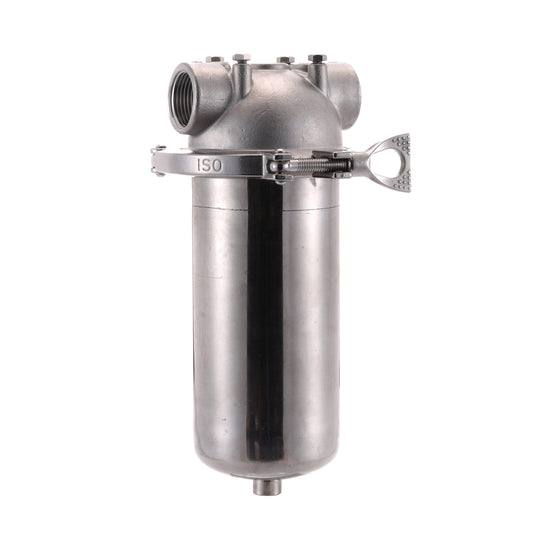
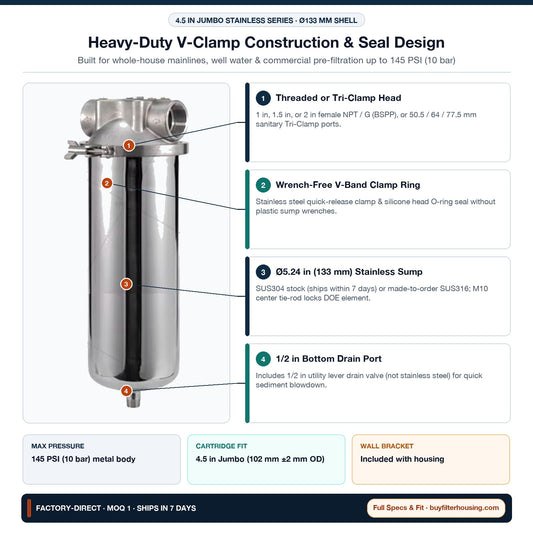
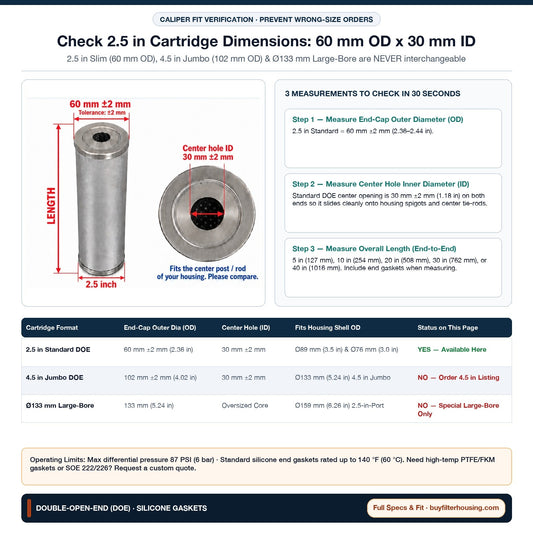
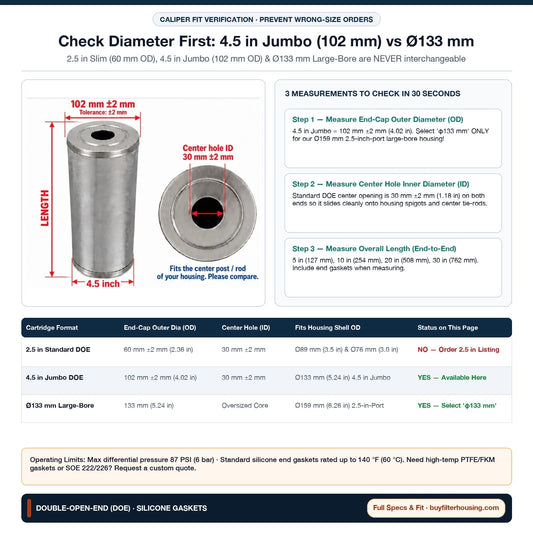
Our stainless steel Jumbo housing takes 4.5 in double open end (DOE) cartridges with an outside diameter of 102 mm, plus or minus 1 mm, and a 30 mm center hole, in 10, 20 or 30 in lengths. The 2.5 in housings take the standard slim cartridge in 5, 10 or 20 in lengths; the size guide lists the diameters and end styles they seat.
How much more does a 4.5 in cartridge hold?
More than the diameter suggests. The outside of a 4.5 in cartridge has 1.8 times the surface of a 2.5 in cartridge of the same length, because surface scales with diameter. The media volume scales with the square of the diameter, less the core: for a melt-blown cartridge with the same center hole, a 4.5 in cartridge holds close to four times the media of a 2.5 in cartridge of the same length. That is the arithmetic behind the longer change intervals and the lower pressure drop of the bigger size.
Cartridge makers publish the result. Hydronix lists its 4.5 x 10 in sediment depth cartridges at a 1 psi initial pressure drop at 10 gpm and the 4.5 x 20 in at 1 psi at 20 gpm (Hydronix SDC spec sheet via Filter Source). Mid Atlantic Water puts the reason for the bigger housing in one word: "The reason a 4.5 inch housing instead of the skinny 2.5 inch ones: flow," and notes that the 20 in version "holds twice the length of filter media, so it lasts longer between changes and handles higher flow" (Mid Atlantic Water, Big Blue guide). Those figures belong to the cartridges named; the flow your housing passes depends on the cartridge you load, so take it from that cartridge's data sheet.
Which flow rate suits each size?
Think in terms of where the housing sits. Point-of-use lines, under a sink, on a single machine, on a dosing or sampling line, run a few gallons a minute and a 2.5 in cartridge handles them. Point-of-entry lines, the main pipe into a house or a small plant, run everything at once, and that is where the 4.5 in size earns its place; Mid Atlantic Water recommends the 20 in Big Blue for most homes and the 10 in for one or two people. For process duty the question is the same: a single machine or rinse station is 2.5 in territory, a line feeding several machines or a reverse osmosis skid is 4.5 in territory, and above that you move to a multi-cartridge housing rather than a bigger single cartridge.
Two things to resist. Do not size up to fix a dirty-water problem; if a 20 in Jumbo cartridge still blocks quickly, the fix is a coarser stage in front, not a bigger housing. And do not size down to save space on a main line; a 2.5 in cartridge on point-of-entry flow drops pressure, blocks fast and costs more in cartridges than the housing saved.
2.5 vs 4.5 filter housing: side by side
| Question | 2.5 in housing | 4.5 in Jumbo housing |
|---|---|---|
| Cartridge | Standard slim cartridge, about 2.5 in diameter | Jumbo / Big Blue cartridge, 102 mm (4.5 in) diameter, 30 mm core |
| Lengths in our range | 5, 10, 20 in | 10, 20, 30 in |
| Media per cartridge, same length | 1x | About 4x by volume, 1.8x by outer surface |
| Typical position | Point of use, single machine, small line | Point of entry, main line, pre-filter for RO or process |
| Change interval at the same flow and dirt | Shorter | Longer, and lower pressure drop |
| Space | Compact; fits under a counter or on a panel | Needs a wall bracket and height to drop the sump |
| Closures in our range | Threaded sump or clamp lid, by model | Clamp closure only |
| Ports in our range | NPT or G (BSPP), size by model | 1, 1.5 or 2 in NPT or G (BSPP), or Tri-Clamp ferrules |
| Cartridge cost per change | Lower per cartridge | Higher per cartridge, lower per unit of dirt held |
Which size for which job?
- Under-sink, coffee machine, ice maker, lab tap: 2.5 in, 10 in long. Flow is low and space is short.
- Whole-house or main supply line: 4.5 in, 20 in long for most homes, 10 in for small ones. Our whole-house filter housing page covers the two sizes and the kits.
- Well water with visible sediment: 4.5 in with a coarse cartridge first; the well water sediment filter page walks through the mesh choice.
- Pre-filter ahead of RO: 2.5 in for a small unit, 4.5 in or multi-cartridge for a skid; see the RO pre-filter housing page.
- Replacing a cracked plastic Big Blue: a stainless 4.5 in housing takes the cartridges you already have, so nothing else changes.
- Reusable element: both sizes take a stainless mesh cartridge, rated in mesh count, that is washed rather than replaced; the Jumbo is listed with mesh elements from 10 to 200 mesh.
Do both sizes use the same ports and closures?
No, and this is where orders go wrong. In our range the Jumbo housing is clamp closure only: a band clamp holds the head to the sump, and the sump drops off without tools once the clamp is released. The 2.5 in housings come as threaded sumps, including a slim 76 mm model and a flat-bottom model, or as clamp lid housings in 1.5 mm electropolished or 2.0 mm polished wall; the wall thickness changes weight, finish and price, not the duty. A clamp closure is not the same as Tri-Clamp ports: the Jumbo is offered with threaded ports, 1 in, 1.5 in or 2 in, in NPT or G (BSPP) parallel thread, not NPT and not PT or R tapered thread, or with sanitary Tri-Clamp ferrules of 50.5, 64 or 77.5 mm. The ferrule diameter is the clamp hardware size, not the bore. NPT vs BSP explains how to tell which thread your pipework has.
Can a 2.5 in cartridge go in a 4.5 in housing?
No. The seats in the head and sump are sized for a 102 mm element; a 2.5 in cartridge sits loose and the liquid bypasses it. The reverse is physically impossible. Pick the housing for the cartridge you want to run, not the other way round, and if you are replacing a housing, measure the old cartridge first: diameter, length and end style. The fit checker returns the housings that match.
What should you check before you order?
- Cartridge diameter and length: 2.5 or 4.5 in, and 5, 10, 20 or 30 in. Measure the old one if in doubt.
- End style: our Jumbo takes DOE cartridges; check the end style on a 2.5 in housing against the size guide.
- Ports: size, and NPT or G (BSPP), or Tri-Clamp ferrule size.
- Closure and space: clamp or threaded, and the height to drop the sump and pull the cartridge.
- Material: SUS304 standard, SUS316 made to order. The grade describes the housing body and can be verified by PMI; the drain valve and fasteners are separate items, and the drain valve is not stainless steel.
- What is in the box: the Jumbo ships with head, sump, clamp ring, head gasket, center rod and lock nut, mounting bracket and a drain valve; there is no wrench to lose, because the clamp needs none.
Anything the two standard sizes do not cover, a longer sump, a different port layout, a vessel for several cartridges, is built to an approved drawing on our custom filter housing page and delivered to the dimensions on that drawing, with a minimum order of one piece.
FAQ
Is a 4.5 in housing better than a 2.5 in housing?
Better for flow and change intervals, because the cartridge holds about four times the media. Worse for space and cartridge price per change. For a point-of-use line the 2.5 in is the right tool; for a main line the 4.5 in is.
Is Jumbo the same as Big Blue?
Yes in cartridge size. Big Blue is a trade name for the blue plastic 4.5 in housings; Jumbo is the generic name for the same cartridge format, so a stainless Jumbo housing takes Big Blue cartridges.
Does a longer cartridge change the diameter choice?
No. Length adds media at the same diameter: a 20 in cartridge holds twice the media of a 10 in. Choose the diameter for the flow and position, then the length for the change interval and the headroom you have.
Can I run a stainless mesh cartridge in either size?
Yes. Our mesh cartridges are listed by mesh count for both the 2.5 in and the Jumbo housings. They are washed and reused rather than replaced, which suits coarse sediment ahead of a finer disposable stage.
Which material should I pick?
SUS304 for most water; SUS316 for chlorides, brine, coastal water or aggressive chemicals, made to order. The grade applies to the housing body, which we can verify by PMI before shipment. See 304 vs 316 for filter housings.
Not sure which size your line needs?
Tell us where the housing sits, the pipe size, the cartridge you want to run and how often you can change it, and we will recommend 2.5 in, 4.5 in or a multi-cartridge vessel, with a drawing for anything non-standard. Start at custom filter housings or request a quote.