Filter Housing Gasket Material: Silicone, EPDM, FKM or PTFE
Share
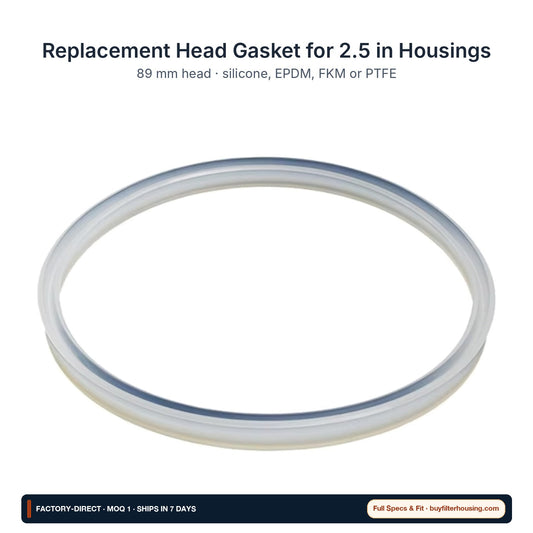
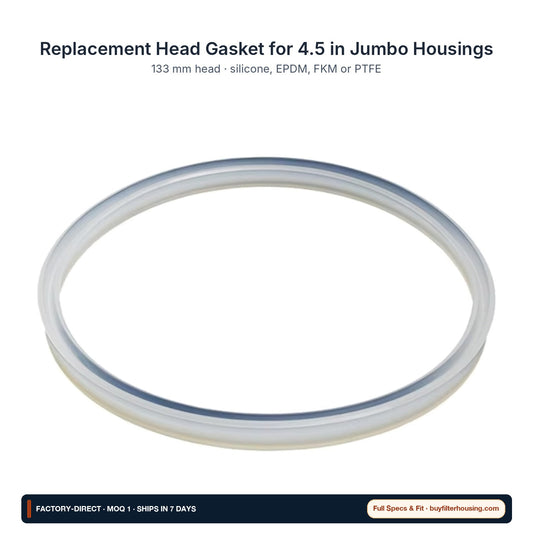
The right filter housing gasket material depends on three things: the liquid, how hot it runs, and what you clean with. For water we recommend silicone or EPDM. For oils, fuels and most solvents we recommend FKM. For aggressive or mixed chemicals where no rubber is safe, PTFE. Our replacement head gaskets come in all four, in two sizes: one for the 89 mm heads on our 2.5 in housings and one for the 133 mm heads on our 4.5 in jumbo housings.
- Silicone: the usual spare for clean water duties. Poor with oils, solvents and strong acids or bases.
- EPDM: our pick for hot water, steam cleaning and caustic wash. Swells in oils and fuels.
- FKM: our pick for oils, fuels and many solvents. Not for steam, ketones or ammonia.
- PTFE: the widest chemical resistance of the four. It is hard, so it needs a clean seat and even closing force.
- Size matters as much as material: the 89 mm and 133 mm head gaskets are not interchangeable, and neither is a tri-clamp ferrule gasket.
Which filter housing gasket material should you choose for your liquid?
Choose the gasket for the worst thing it will touch, not the liquid you run most days. A housing on water that gets a caustic wash every week needs a gasket that survives the wash. A housing on diesel that is rinsed with water needs a gasket that survives the diesel. Start from the table and then check your cleaning chemical against it.
| What the gasket touches | Gasket we would choose | Why, and what to avoid |
|---|---|---|
| Cold or warm water, well water, rainwater, RO feed water | Silicone or EPDM | Both handle water. Silicone is the usual spare for our housings; EPDM is the tougher choice if the line is ever hot-washed. |
| Hot water, steam cleaning | EPDM | EPDM is the standard elastomer for hot water and steam. Silicone and FKM both do poorly in steam. |
| Caustic wash (sodium hydroxide cleaners) | EPDM | EPDM resists bases. Silicone does not hold up to concentrated acids or bases. |
| Diesel, hydraulic oil, lubricating oil | FKM | FKM resists petroleum oils and fuels. EPDM swells badly in oil and silicone swells too. |
| Solvents such as alcohols | EPDM or PTFE | EPDM handles alcohols. Check anything else by name before ordering. |
| Ketones such as acetone or MEK | PTFE or EPDM | FKM and silicone are both attacked by ketones. This is the most common FKM mistake. |
| Ammonia or amine-based chemicals | EPDM or PTFE | FKM is poor with amines. |
| Acids, oxidizers, mixed or unknown chemicals | PTFE | PTFE is inert to most fluids. Send us the chemical and concentration and we will confirm before you order. |
The chemical behavior in this table follows published seal guides. Marco Rubber's material chart lists EPDM as good with "Hot Water and Steam" and not recommended for "Petroleum Oils" and "Fuels", and lists FKM as not recommended for "Ketones (MEK)", "Amines (Ammonia)" and "Hot Water and Steam (except specialty grades)" (Marco Rubber O-ring material chart). Polymax sums up the same four in a line each: EPDM "excellent with water, steam, mild acids" and "poor with oils"; FKM "excellent with fuels, oils, solvents" and "poor with steam/amine"; PTFE "inert to most fluids" (Polymax material guide). A chart tells you about the rubber family, not your exact mix, so for any chemical duty send us the details.
What size is the head gasket on our housings?
Our housings use two head gasket sizes, and the material options are the same for both. The gasket for 89 mm heads fits every 89 mm 2.5 in threaded and clamp housing in our catalog. The gasket for 133 mm heads fits the 4.5 in jumbo clamp housings. These are the dimensions we list for the FKM version of each.
| Dimension (FKM gasket) | For 89 mm heads (2.5 in housings) | For 133 mm heads (4.5 in jumbo housings) |
|---|---|---|
| Outside diameter | 106 mm | 145 mm |
| Inside diameter | 86 mm | 125 mm |
| Centerline diameter | 98 mm | 135 mm |
| Thickness at the bead | 5.6 mm | 5.4 mm |
| Thickness at the edge | 1.7 mm | 2 mm |
| Materials sold | Silicone, EPDM, FKM, PTFE | Silicone, EPDM, FKM, PTFE |
If you are replacing a gasket on a housing from another maker, measure the old one against these numbers before ordering. A gasket that is 2 mm off in diameter will not seat, whatever it is made of. The 2.5 in replacement head gasket and the jumbo replacement head gasket are separate products for that reason.
Is a tri-clamp gasket the same as a head gasket?
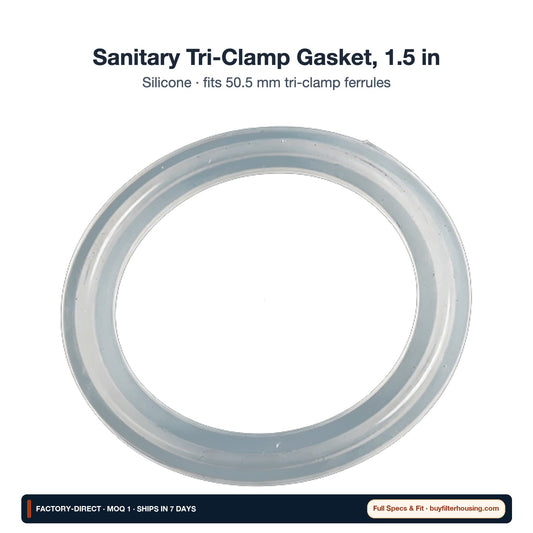
No. A tri-clamp gasket seals the joint between two ferrules on the inlet or outlet. A head gasket seals the lid to the sump. Our 50.5 mm tri-clamp gasket fits 1.5 in ferrule joints and is silicone; it will not fit a housing head. If your jumbo housing has 64 mm or 77.5 mm ferrules, ask us for those sizes. The difference between the lid clamp and tri-clamp ports is covered in filter housing parts explained.
When does PTFE make sense, and what is the catch?
PTFE makes sense when the chemical rules out every rubber, or when one housing sees several different chemicals. The catch is that PTFE is a hard plastic, not a rubber. It does not spring back, and it can slowly creep under a clamp that is left tight for a long time. GW Kent's gasket guide puts it this way: "PTFE gaskets can cold-flow under sustained compression" (GW Kent gasket material selection).
In practice that means three things on our housings. Wipe the gasket groove clean before fitting. Close a clamp lid evenly, and close a threaded lid by hand until it seats. Check the seal after the first heat-up and cool-down, because that is when a PTFE gasket settles. If your line runs on water, PTFE gains you nothing over silicone or EPDM and is harder to seal.
Does a 316 housing need a different gasket from a 304 housing?
No. The head is the same size in SUS304 and SUS316, so the gasket is the same part. What changes is why you bought 316. If you chose 316 for chlorides, brine or a chemical, the gasket has to resist that liquid too, and the default water gasket may not. We treat the body grade and the gasket material as two separate lines on the quotation, and the drain valve is not stainless steel in either grade. The steel side of that decision is in filter housings for chemicals and brine, and the wider picture is in our stainless steel filter housing buyer's guide.
How do you know a gasket needs replacing?
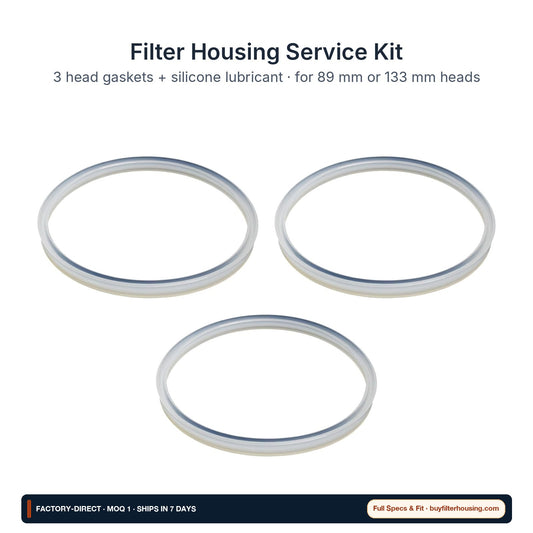
Replace the head gasket when it is swollen, hardened, cracked, flattened on one side, or sticky to the touch. Swelling and stickiness mean the material is wrong for the liquid, so change the material, not only the gasket. Flattening and hardening are normal wear. Look at it at every cartridge change and keep one spare per housing. Spares for both sizes are in parts and accessories.
FAQ: filter housing gasket material
Which gasket comes with a new housing?
Every 89 mm 2.5 in housing and every 4.5 in jumbo housing ships with one head gasket installed. Silicone is the usual spare. If your duty needs EPDM, FKM or PTFE, tell us when you order and add the matching spare.
Can I use an EPDM gasket with oil?
No. EPDM swells in petroleum oils and fuels. Use FKM for oil, diesel and hydraulic fluid.
Can I use an FKM gasket with steam or hot caustic?
FKM is not recommended for steam. For steam cleaning use EPDM. For any hot chemical wash, send us the cleaner name and concentration and we will confirm the gasket.
Will the 2.5 in gasket fit a jumbo housing?
No. The 2.5 in gasket is 106 mm outside diameter and the jumbo gasket is 145 mm. They are different parts.
Is FKM the same as Viton?
Viton is a trademarked brand of FKM. Our gasket is sold as FKM.
Can you supply a gasket for a custom vessel?
Yes. On custom bag and multi-cartridge vessels the gasket material is written on the drawing you approve, and the vessel is delivered to drawing dimensions. Start at custom filter housings.
Not sure which gasket your line needs? Send us the liquid, its concentration, the operating temperature and your cleaning chemical, plus a photo of the old gasket if you have one. We will tell you the material and the size, with MOQ 1.