PVDF Filter Housing vs 316 Stainless for Chemicals and Brine
Share
For most brine and salt water duties, a 316 stainless steel filter housing is the right choice; for oxidizing dosing chemicals, above all sodium hypochlorite, and for hydrochloric acid, no grade of stainless steel is, and the housing should be a PVDF filter housing or another fluoropolymer or thermoplastic body. The dividing line is chloride and oxidizing power. Chloride attacks stainless steel by pitting, and the amount it tolerates depends on grade, temperature, pH and whether the liquid sits in crevices; hypochlorite and strong acids attack it outright. Seals are a separate decision again, chosen for the chemical rather than the shell. The rules of thumb:
- 304: clean, cool water up to roughly 150 mg/L chloride; cooling tower and brackish duties usually exceed that.
- 316: roughly 400 mg/L chloride on clean surfaces, lower above 35 °C or below pH 7, and lower again where liquid stands in a crevice.
- Seawater and saturated brine: hundreds of times above those limits; stainless there depends on short exposure, cool temperature and rinsing, and a plastic body is the lower-risk answer.
- Sodium hypochlorite, hydrochloric acid, ferric chloride: PVDF or PTFE wetted parts, no stainless.
- Seals: EPDM for water and many dilute chemicals, FKM for acids and oils, PTFE or FFKM for oxidizers.
This is the chemical service chapter of our stainless steel filter housing buyer's guide. 304 vs 316 covers the grade choice for ordinary water; this article covers the liquids where the grade choice is not enough.
When is a 316 stainless steel filter housing enough for brine?
When the chloride level, the temperature and the geometry stay inside what 316 tolerates. A materials selection article in Power Engineering gives the working numbers: on clean surfaces with no deposits or crevices, type 304 is limited to about 150 mg/L chloride and type 316 to about 400 mg/L, and both limits should be lowered above 35 °C and below pH 7 (Power Engineering, how much chloride?). The authors' cooling tower example shows how fast a modest makeup water crosses the line: 50 mg/L chloride at five cycles of concentration is 250 mg/L in the circulating water, enough to rule out 304 on its own. The failure mode is pitting. Chloride breaks down the passive oxide film at a point, a pit forms, and because the metal loss is tiny the wall can be penetrated with no warning. Deposits and crevices make it worse, because under a deposit the pH drops and the chloride concentrates far above the bulk figure.
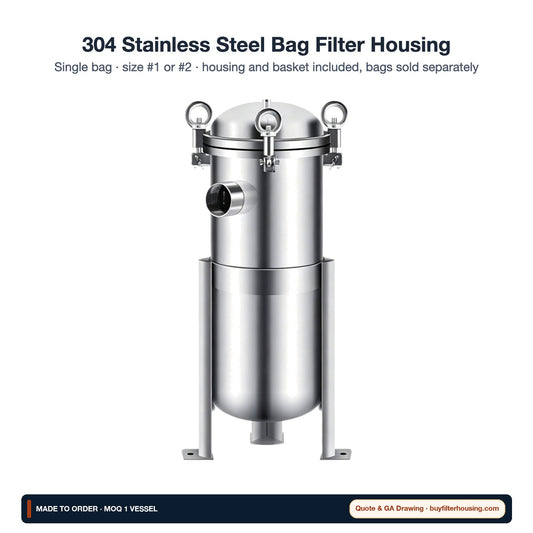
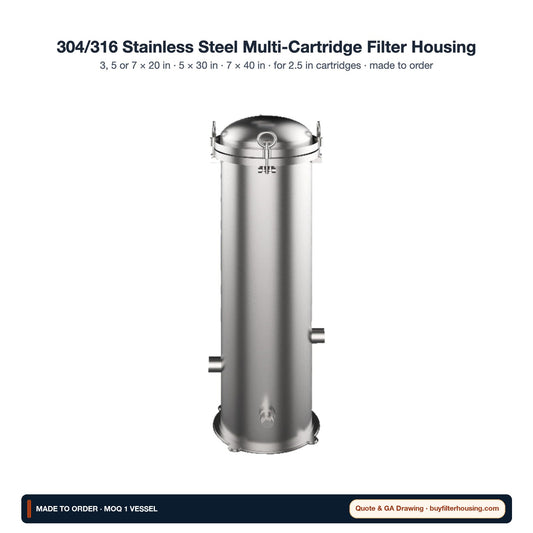
A filter housing is full of crevices: the bag seat, the gasket faces, the thread roots, the gap under a basket rim. So the honest reading of the numbers is this. Brackish well water, cooling tower side streams, chloride-bearing process water and lines cleaned with chloride sanitizers are 316 duties, and the bag filter housings and multi-cartridge housings are quoted in SUS316 for them. Seawater and the saturated brine that regenerates a water softener are a different order of magnitude, and a stainless housing on them is relying on short contact, cool liquid and a thorough rinse when the line is idle; if the housing will sit full of brine between cycles, a thermoplastic body is the safer specification. Two reminders that apply to every 316 housing: the grade describes the body, and the gasket, fasteners and drain valve are on their own lines, and the drain valve we fit as standard is not stainless steel; and the body grade can be checked on the finished housing with a PMI reading, as this article explains.
When do you need a PVDF filter housing instead?
When the chemical attacks stainless steel regardless of grade. The clearest case is sodium hypochlorite, the bleach used for disinfection dosing. ICON Process Controls, writing about hypochlorite dosing instrumentation, states that "Stainless steel components often experience pitting corrosion and progressive surface degradation," and that "Corrosion-resistant materials such as PVDF and PTFE are specifically recommended for equipment handling sodium hypochlorite" (ICON Process Controls, sodium hypochlorite systems). The same article notes that hypochlorite "continuously decomposes and releases oxygen gas," so a housing on a bleach line needs a vent, not only a drain. Hydrochloric acid, ferric chloride and acidic chloride mixtures belong in the same group: oxidizing or acidic, chloride-rich, and hostile to the passive film that stainless steel depends on.
A PVDF housing for these duties is normally an all-plastic vessel rather than a lined steel one. United Filtration describes its Kynar housings as "Constructed entirely of Kynar" and "an economical solution for corrosive applications," with a threaded head-to-bowl closure and a Viton O-ring as the standard seal (United Filtration, Kynar filter housings). That construction is typical of the small cartridge housings used on dosing skids. Larger chemical vessels are sometimes steel shells with a fluoropolymer lining, which keeps the pressure strength of steel and the chemical resistance of the plastic but adds a lining to inspect. We quote PVDF housings and cartridges for chemical service alongside the stainless range; the chemical, its concentration and the temperature decide what is offered, and the quotation names the body, seal and cartridge materials for your duty. Start on the custom filter housing page.
Which seal material goes with which chemical?
The gasket or O-ring is wetted, and it fails before the shell does when it is wrong. A seal guide from Electric Solenoid Valves rates the common materials: EPDM "Excellent for water, steam, and mild chemicals" but with "Poor resistance to oils and hydrocarbons"; NBR excellent for oil but poor for acids, with "Limited chemical resistance" that "degrades at higher temperatures"; FKM good for acids and excellent for oil; PTFE the broadest resistance of all, limited by low mechanical strength and creep under load (Electric Solenoid Valves, seal materials guide). For strong oxidizers, ICON Process Controls points to FFKM where elastomer seals would otherwise swell or crack.
| Seal | Suits | Avoid | Notes for a filter housing |
|---|---|---|---|
| EPDM | Water, brine, steam, dilute alkalis, many dilute acids | Oils, hydrocarbons, solvents | The usual choice on water and brine housings |
| NBR (nitrile) | Oils, fuels, cutting coolant | Acids, oxidizers, hot water | Common on general-purpose housings; replace it on chemical lines |
| FKM (Viton) | Acids, oils, many solvents, higher temperatures | Hot water and steam, some ketones and amines | Standard on PVDF chemical housings |
| PTFE | Almost all chemicals, including hypochlorite | Nothing chemical; creeps under load, poor spring-back | Flat gaskets on clamp and bolted covers; needs a stiff flange |
| FFKM | Strong oxidizers, aggressive mixtures | Cost | O-rings where elastomer resilience and oxidizer resistance are both needed |
Housing body and seal by liquid
| Liquid | Housing body | Seal | What decides it |
|---|---|---|---|
| Process or well water, low chloride, cool | SUS304 | EPDM | Chloride under roughly 150 mg/L, no deposits |
| Brackish water, cooling tower side stream, chloride sanitizer rinse | SUS316 | EPDM | Chloride up to a few hundred mg/L; temperature and pH |
| Seawater, softener regeneration brine | SUS316 only with short contact and rinsing; otherwise thermoplastic | EPDM or FKM | Whether the housing sits full between cycles |
| Sodium hypochlorite dosing | PVDF | FKM, PTFE or FFKM | Oxidizer; vent for off-gassing |
| Hydrochloric acid, ferric chloride | PVDF | FKM or PTFE | Acidic chloride attacks every stainless grade |
| Sodium hydroxide, other alkalis | Usually stainless; confirm by concentration and temperature | EPDM or PTFE | Some plastics are weaker against strong bases than against acids |
| Solvents, oils, coatings | SUS304 or SUS316 | FKM or PTFE | The seal, not the shell, is the limit |
What should you send for a chemical or brine housing quote?
Five things decide the materials, and none of them is the flow rate. First, the chemical by name and concentration: "bleach" is not a specification, "sodium hypochlorite 12.5%" is. Second, the temperature, both running and during cleaning. Third, for brine and salt water, the chloride figure in mg/L if you have it, and the pH. Fourth, the duty cycle: continuous, intermittent, and whether the housing is drained or sits full when idle, because stagnant brine in a crevice is where pitting starts. Fifth, what else touches the liquid: cleaning chemicals, and whether the line is ever shocked with a sanitizer. Add the usual flow, micron rating, element type and port details from the quote checklist, and the quotation comes back naming the body material and the seal material separately, with a drawing to approve for a custom vessel. We do not judge a housing against your chemical from the name alone; the concentration and temperature are what make the answer honest.
FAQ
Is a 316 stainless steel filter housing safe for seawater?
Not without conditions. Seawater is far above the chloride level 316 tolerates on standing contact, so a 316 housing on seawater depends on cool liquid, short exposure and rinsing when idle. Tell us the duty cycle, and ask about a thermoplastic body if the housing sits full.
Can I use a stainless housing for bleach dosing if I rinse it?
We would not recommend it. Hypochlorite pits stainless steel in service, not only when stagnant, and the industry guidance is PVDF or PTFE wetted parts. Specify a PVDF housing with an FKM, PTFE or FFKM seal and a vent.
Which gasket for a brine housing?
EPDM in most cases. Switch to FKM if oils or solvents are present, and to PTFE if the brine is mixed with an oxidizer.
Are PVDF housings all plastic, or steel with a lining?
The small cartridge housings used on dosing lines are all PVDF, with a threaded closure and an O-ring seal. Larger chemical vessels may be steel with a fluoropolymer lining. Send the chemical, concentration, temperature and flow, and the quotation says which construction can be offered for your duty.
Does 316 mean the drain valve and gasket are also chloride-resistant?
No. SUS316 describes the housing body. The gasket is an elastomer chosen for the chemical, and the drain valve we fit as standard is not stainless steel; ask for an all-stainless valve before ordering if your specification needs one.
Filtering something that bites?
Send the chemical name and concentration, the temperature and the duty cycle, and the quotation names the body and seal materials for it, stainless or PVDF, with a drawing to approve on a custom vessel. Housings are delivered to drawing dimensions, the stainless body grade is verifiable by PMI, and one housing is a normal order. Start at custom bag and multi-cartridge filter housings or request a quote.