Factory Direct vs Trading Company: Stainless Filter Housings
Share
Factory direct or trading company matters less than seven answers. A factory-direct supplier builds the housing you are buying and can show you how; a trading company buys it from a factory and resells it, sometimes well, sometimes without ever seeing the drawing. For a stainless steel filter housing, where the product is a grade of steel, a thread form and a set of dimensions held or missed, the thing to settle before you order is not the label on the website but whether the people quoting you can read your drawing, prove the material and stand behind the dimensions. Ask these seven questions of any stainless steel filter housing manufacturer or reseller, and the label sorts itself out:
- Can you work from my drawing, and can you produce one for approval?
- Who answers technical questions, and do I talk to them directly?
- What grade is the body, and how will I verify it?
- What is checked against the drawing before shipment?
- What is the minimum order?
- Whose name is on the registration, the quotation and the invoice?
- Can I visit, or send an inspector?
This is the supplier chapter of our stainless steel filter housing buyer's guide. How to choose a bag filter housing manufacturer covers what to look for in the housing itself; this article covers who is selling it to you.
What is the difference between factory direct and a trading company?
A factory owns the shop floor: the rolling, welding, polishing and testing happen under its roof, and its engineers set the price and the schedule. A trading company owns a customer list and a supplier list; it takes your order, places it with a factory and manages the result. Neither is dishonest by itself. The trouble starts because, as the sourcing platform SourceReady puts it, "Many trading companies market themselves as manufacturers" (SourceReady, factory vs trading company). The classic differences, from guides that cover every product category: a trader is "often more expensive (5 – 10%) than the original manufacturer" but can take smaller orders because one factory batch is split among several buyers (China Importal, trading companies and manufacturers); a trader's staff usually speak better English and know export paperwork, but every message passes through two parties, and a trader "may even change the factories, which makes it possible that the quality is not stable" (V-Trust, trading companies vs factories). On a filter housing that last point is the one that bites: a change of factory can mean a different seat, a different drain position or a different thread on the "same" model.
When does a trading company make sense?
When you are buying several unrelated product categories in small quantities and want one invoice, one shipment and one contact who speaks your language. SourceReady credits trading companies with consolidating suppliers, managing quality and simplifying international sourcing, and that is real value for a buyer filling a container with mixed goods (SourceReady). It is less relevant when you are buying one custom pressure vessel to a drawing. There, every link in the chain between you and the welder is a place for a dimension to go wrong, and you want the chain as short as possible.
How do you tell a stainless steel filter housing manufacturer from a trading company?
Not by asking "are you a factory?" Everyone says yes. Ask these seven and judge the answers together; SourceReady's caution applies: "No single indicator proves a supplier is a trading company."
1. Can you work from my drawing, and produce one for approval?
Send a drawing, or a sketch with ports, flow direction and closure, and ask for a general arrangement drawing back. A manufacturer's engineer reads your sheet, asks about the thread form if you wrote "1 in BSP" without G or R, and returns a drawing with a nozzle schedule and a parts list. A pure reseller forwards your file and returns a price. The returned drawing is the most useful document in the whole transaction; how to read a filter housing drawing covers what to check on it.
2. Who answers technical questions, and do I talk to them directly?
Ask something only a shop would know: how the basket seat is welded, what the inside finish is after welding, how a 226 O-ring cup differs from a double open end seat. SourceReady lists it among its ten tells: factory staff tend to answer production questions without relaying them, and direct access to engineers or production supervisors points to a manufacturer (SourceReady). A two-day silence followed by a copied paragraph is the other sign.
3. What grade is the body, and how will I verify it?
The answer should name the grade for the body and admit that the drain valve, gasket and fasteners are separate items with their own materials. Then ask how you verify it. A handheld PMI reading gives chromium, nickel and molybdenum percentages on the finished housing, which separates 304 from 316; how to verify 316 with PMI walks through it. A supplier who controls production can offer a reading on your housing before it ships. A supplier who does not can only forward what the factory told them.
4. What is checked against the drawing before shipment?
Ask which dimensions are measured on the finished vessel and whether you get the figures. The honest answer names the overall height, the port centerlines, the port threads or flange standard and the leg height, measured against the approved drawing. "Delivered to drawing dimensions" is a commitment a manufacturer can make because it controls the measuring; a reseller can only pass the claim along.
5. What is the minimum order?
Sourcing guides expect factories to want larger minimums, because material is bought in bulk, and traders to accept small orders by splitting a batch (China Importal). Custom pressure vessels break the pattern: a filter housing is built one at a time to one drawing, so a fabricator that quotes a minimum of one piece is describing how it works. A minimum of fifty on a custom vessel suggests somebody in the chain is buying stock from someone else.
6. Whose name is on the registration, the quotation and the invoice?
Ask for the registered company name and compare it with the name on the quotation and the name you will pay. SourceReady points to the business registration: a scope that lists manufacturing supports a factory claim, while import, export or wholesale points to trading. Many Chinese factories have no export license and ship through an export company, so a factory plus a trading arm is normal (China Importal). The point is not to catch anyone out but to know which company builds the housing and which company answers to you if it arrives wrong, and to have both names before you pay.
7. Can I visit, or send an inspector?
A manufacturer generally accepts a visit or a third-party inspection; SourceReady lists audit willingness among its tells, together with factory photos that match the equipment and branding you were shown. A trader can host you at a partner's plant, so on a visit ask which company occupies the site and compare the names on the gate, the business cards and your quotation. If a visit is out of reach, a pre-shipment inspection against the approved drawing does most of the same work.
Factory direct vs trading company: comparison
| What you are judging | Factory direct | Trading company |
|---|---|---|
| Price | Typically lower, no intermediary margin; a factory may ask a larger deposit (V-Trust) | Typically 5–10% higher (China Importal) |
| Minimum order | Often higher on catalog goods; one piece on a custom vessel built to drawing | Lower on catalog goods, by splitting a batch |
| Who reads your drawing | The engineer who will build it | Forwarded to the factory, answers relayed |
| Technical questions | Answered from the shop floor | Relayed, with delay |
| Material verification | PMI reading on your housing before shipment | Depends on the factory behind them |
| Quality consistency | One shop, one process | Can change factories between orders (V-Trust) |
| Product range | Narrow, specialized | Wide, across many factories |
| Language and paperwork | Variable | Usually stronger (V-Trust) |
| Accountability | The builder | The intermediary; a refund or remake goes through them (China Importal) |
Where does SS Filter Housing sit?
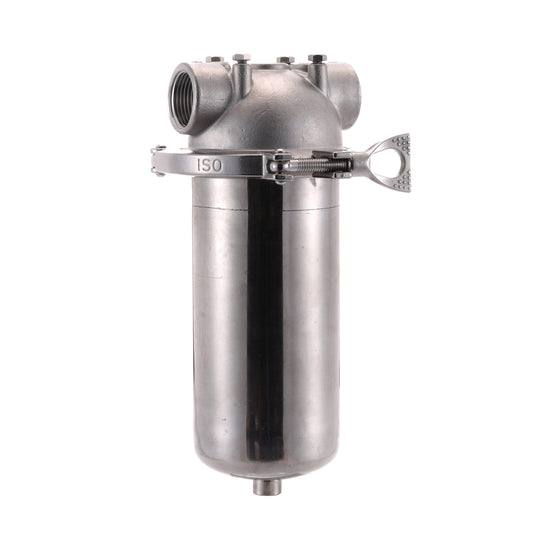
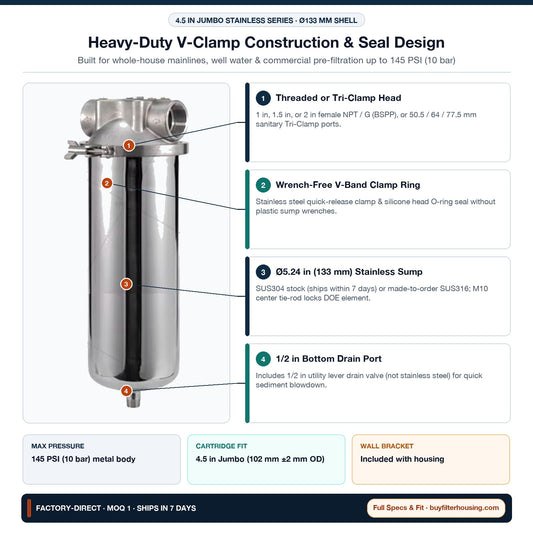
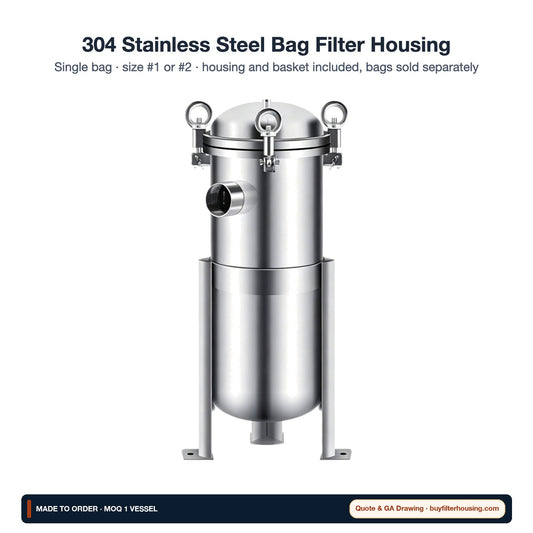
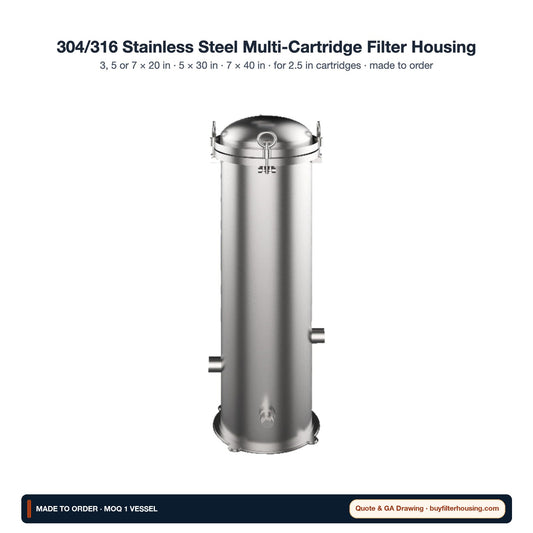
We have worked in stainless steel filtration for 7–8 years in close cooperation with the factory that builds our housings, which in practice is factory direct: your drawing goes to the people who weld it, or we produce the drawing for your approval; the body grade is verifiable by PMI; the housing is delivered to the dimensions on the approved drawing; and the minimum order is one piece, for a stock housing or a custom vessel. Ports, closure, material, finish and supports are specified on the drawing, not picked from a reseller's catalog. Stock stainless steel filter housings ship from the catalog; custom bag and multi-cartridge vessels start on the custom filter housing page. The company behind the store is on the About page, and you are welcome to ask us the seven questions above.
FAQ
Is factory direct always cheaper?
Usually, but not by the whole margin. Sourcing guides put a trader's markup around 5–10% (China Importal), while V-Trust notes that factories often ask for larger deposits and are slower with small orders. On a one-off custom vessel, a drawing read correctly the first time is worth more than the margin.
Is buying from a trading company a mistake?
No. For mixed small orders across categories it is often the right choice. For a custom pressure vessel, ask the seven questions and make sure you know which company builds it and which one answers for it.
Why do so many factories sell through a trading company?
Export paperwork. Many manufacturers have no export license and ship through an export company (China Importal). That is normal; get both names in writing.
How do I check that a 316 housing is really 316?
A handheld PMI reading on the finished housing gives the chromium, nickel and molybdenum percentages. Ask for it before shipment, and remember it covers the body, not the valve or the gasket.
What should I send to get a quote?
Liquid, flow, solids, pressure, ports with thread form or flange standard, closure, finish and quantity. The quote checklist lists all ten items.
Ready to ask us the seven questions?
Send your drawing or your duty and see how the answers come back: a drawing for approval, a named body grade you can verify by PMI, delivery to drawing dimensions and a minimum of one. Start at custom bag and multi-cartridge filter housings or request a quote.